




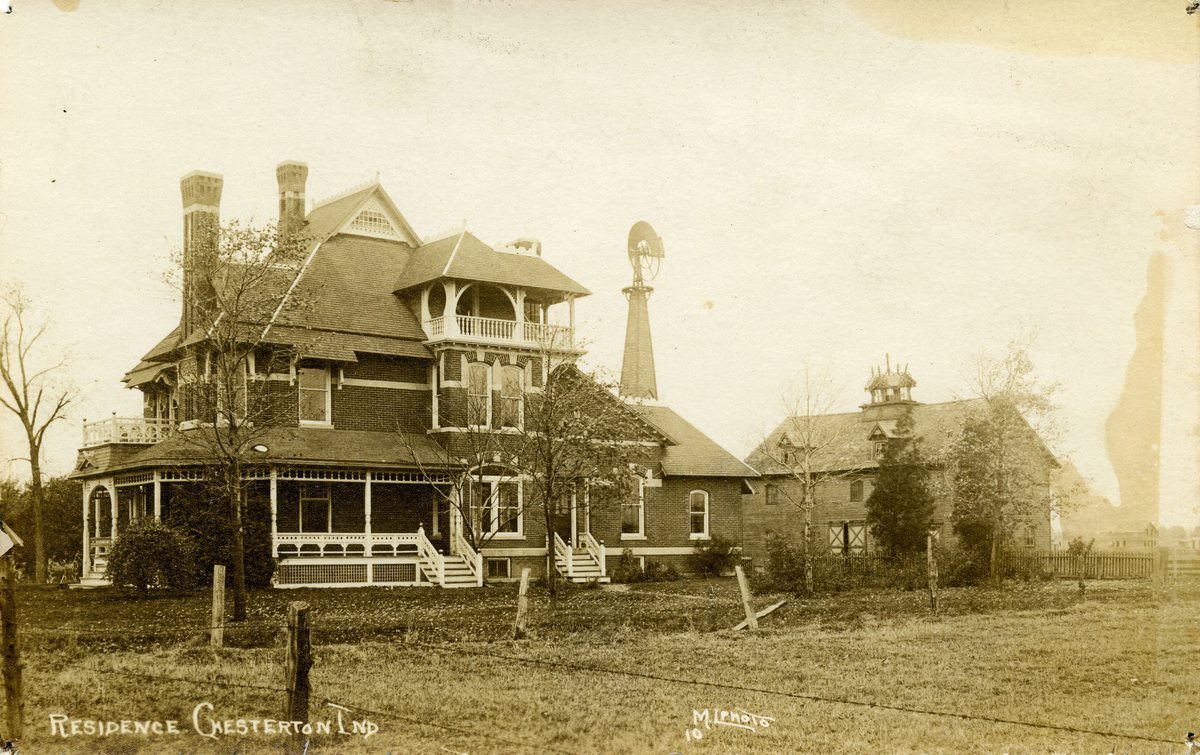
CHESTERTON, Ind. On Christmas Eve 1885, the front page of the Chesterton Tribune carried a drawing that took up most of the top of the page, a tall brick house with a sweeping porch and chimneys reaching over its roof, under the title "Residence of George Brown, Esq."
"This house has been built during the present year in a charming location adjoining Chesterton, Ind.," the paper told its readers. "It commands a beautiful view of the surrounding country."
The Tribune walked readers through it room by room. The outside walls were "selected cherry colored brick," banded with stone, and the front chimney carried two panels of raised tile "in blue and brown." A wide veranda ran along the south and east sides, and on the east side, level with the roof, a balcony looked out over the countryside "from the south, north, east and west." Inside were sliding doors, bay windows, cherry and oak woodwork, stained glass over the doors and frescoed ceilings, a bathroom upstairs with hot and cold water, furnaces for heat and, up in the attic, "a large room ... which can be used as a ball-room." The furniture, the paper said, would be made for the house by a Grand Rapids firm and would most likely be in by spring.
That house still stands at 700 W. Porter Ave., where the township's history museum moved in 2005, and the Westchester Public Library, which bought the property in 2024, is now restoring it.
The farmer who sold wood to the brickyards
George Brown was born in Cumberland County, England, on Dec. 28, 1828, according to the 1882 county history, "Counties of Porter and Lake, Indiana." He came to America in 1852 with a sister and her husband, stayed a while in New York state, went on to La Porte and then settled in Jackson Township in Porter County. On July 17, 1855, he married Charity A. Carter, and the couple raised 10 children.
"Starting with nothing but his hands and brain," the Tribune wrote in 1885, "he has risen to the possession of a handsome fortune." He settled Jackson Township "when it was a wilderness," the paper said, bought land when it was cheap and covered with forest, and cut the timber into lumber and wood. Some years, he sold "as high as three and four thousand cords of wood to the brick yards."
Those were the brickyards of Porter, where eight yards were at work in the 1880s and the Chicago Hydraulic Brick Co. soon set up a factory, according to the house's National Register nomination. The Porter yards were a major supplier to Chicago's growing construction market until around the turn of the century, the nomination says, when dwindling clay and other suppliers put them out of business. Cordwood from the Browns' land fueled those yards and made the family wealthy, and Brown dealt in grain and livestock, too. By 1882, the county history counted him among the largest landowners in Jackson Township, with about 900 acres.
He was a hard worker in politics, though never for himself. The Tribune called his politics "unmixed Jacksonian democracy" and said he had worked tirelessly for the late John N. Skinner's run for Congress on the Greenback and Democratic ticket. Skinner lost, and Brown and his fellow workers took the defeat "with the dignity of a philosopher," the paper said, until "the success of the democrats in 1884 in electing Cleveland, Hendricks and Gray, wiped out all previous disappointment." Brown was "no office-seeker," the paper added: "He wants no office within the gift of man, and would under no circumstances accept one, were it offered."
A house to spend his days in
Brown had decided to partly retire from "the active life he had been leading," the Tribune said, and built the house on a farm at the edge of town "in which to spend the remainder of his days." The estate on the south side of Chesterton took in 10 acres with an orchard and gardens, the nomination says.
He hired a Chicago architect, Cicero Hine, and builders from Chesterton and Valparaiso. The Tribune named the contractors: Nathan Demass of Chesterton for the woodwork, Henry Lembster of Valparaiso for the brickwork, Chris Lembke for the plaster, and Swan Nilson of Chesterton as painter and fresco artist. "All material in the building is of superior quality," the paper said, "and is put in place in a masterly manner." A Miss Cora Greene is said to have carved the staircase woodwork, the nomination says. The plans also called for a carriage house, a coal furnace and a windmill to pump water to the kitchen and to the bath and shower on the second floor.
On the front chimney, at the height of the upper window, the builders set a limestone tablet carved "18 GB 85," topped by a scroll, and it was still there when the house was photographed for the National Register in 1997, the nomination says.
Born in England in 1849, Hine came to America with his parents two years later, worked as a draftsman in Gurdon Randall's Chicago office from about 1869 to 1875, spent several years in the office of Canada's government architect in Ottawa and came back to Chicago in 1883, according to the nomination. A drawing of the Brown house ran in the Inland Architect and Builder in January 1886 with his name on it. In 1913 he closed his own practice to become staff architect for Brunswick, Balke and Collender, a firm that designed pool halls, bowling alleys and their equipment, and he stayed there until his death in 1925.
The nomination calls the house an eclectic blend of Queen Anne, Victorian Gothic and Romanesque Revival, and says nothing in Chesterton compares with it. "Though little known today," it says of Hine, he "was apparently well known in Chicago in the 1870s through the 1890s."
Summers, renters and a schoolhouse office
George Brown died in 1899, the nomination says, and the two published accounts of what came next do not agree. The nomination says that after both parents were gone, the youngest of the children, Carrie, sold the house to George's brother Frank, who sold it shortly after the Depression. The history center's own timeline says George and Charity's son and daughter-in-law, Frank and Fredericka Brown, inherited the house in 1901 and raised their two daughters in it, and that Fredericka, by then a widow, sold it in 1942.
Both accounts agree on the buyers, Dr. Gerald and Nina Gustafson of Indianapolis, who used it for summer vacations. Dr. Gustafson had admired the house when he was a boy growing up in Chesterton, according to the nomination. The Gustafsons rented the first floor to the Chesterton High School principal, Buell Crum, and his family. In 1949, they took the first floor for themselves in the summers and rented out the second, and Dr. Gustafson's mother and an aunt lived there at times. Sometime in the 1940s, the big wraparound porch came off.
After the doctor died in the early 1950s, Nina Gustafson kept the house as a rental, and in 1963 she sold it to the Westchester Township School Corp., the nomination says.
The school corporation remodeled the house through the 1960s and 1970s. Then, in 1983, the Duneland School Corp., formed when Westchester merged with other schools, began a two-year, $237,454 project to rehabilitate it, the nomination says, keeping its Victorian character while making it a modern headquarters. A citizens advisory committee watched over the work with Scott Sauter Ltd. Suspended ceilings and carpeting that had gone in over the years came out, missing woodwork was brought back from storage and put in place, and the original shutter blinds were stripped, refinished and rehung. Where traces of the old ceiling stencils survived, Sauter used them as patterns for new ones. A large addition went on the back, and in 1985 the house went back to work as the school corporation's administrative offices.
When the house was written up for the National Register in 1997, the nomination said a visitor coming in through the original front doors would find that the interior "feels much as it might have a century ago." The National Park Service entered the George Brown Mansion on the National Register of Historic Places on Aug. 28, 1998.
The Duneland History Center
The Westchester Public Library started a township history museum in 1998, and in 2005, the library says, it reached an agreement with the Duneland School Corp. to lease the school corporation's former administration building and historic home as the museum's new location.
Today it is the library's Duneland History Center, "housed in the historic 1885 Brown Mansion," the library says. Its archives hold maps, phone books and newspapers about local people, places and businesses, the papers of the Chicago-based Prairie Club that was active in the dunes from 1908 into the 1960s, and the Chesterton Tribune Photo Archives of Duneland images the paper published.
The library's director told the board at its Oct. 8 meeting that the Brown Mansion "has been officially closed to visitors due to the ongoing construction and the storage of artifacts throughout the building, making tours impossible," according to the board's draft minutes. The library is restoring the house, fixing its roof and structural plaster, and Berglund Construction is building a barn beside it that replicates the property's original one, with climate-controlled archives and space accessible under the Americans with Disabilities Act. The library says the project is paid for from its Library Improvement Reserve Fund with no new tax levy and plans a grand opening of the Duneland History Center in June 2027, and the center takes questions at 219-983-9715.
The newspaper that showed off George Brown's house in 1885 now has its photo archives in the care of the history center that calls the house home. A farmer who came over from England and started, as the Tribune said, with "nothing but his hands and brain" built himself a house to spend the remainder of his days in, and it has outlasted him by well over a century, with his initials and the year carved into its chimney and its rooms waiting to open again to the town it was built beside.
Correction, Nov. 27, 2026: An earlier version of this story listed public hours for the Duneland History Center and said it would reopen to visitors Saturday, Nov. 28. The Brown Mansion is closed to visitors during its restoration and construction, and the library plans a grand opening in June 2027. The earlier version also gave only the National Register nomination's account that George Brown's brother Frank bought the house from Carrie Brown; the story now also gives the history center's account that Frank was George's son and that his widow, Fredericka, sold the house in 1942.
See also
Label: Reported by us.
Corrections
Correction, Nov. 27, 2026: An earlier version of this story listed public hours for the Duneland History Center and said it would reopen to visitors Saturday, Nov. 28. The Brown Mansion is closed to visitors during its restoration and construction, and the library plans a grand opening in June 2027. The earlier version also gave only the National Register nomination's account that George Brown's brother Frank bought the house from Carrie Brown; the story now also gives the history center's account that Frank was George's son and that his widow, Fredericka, sold the house in 1942.
If something else here is wrong, tell us. Every correction is dated on the story and listed in our public log.
Sources (9)
- Brown, George, Mansion, National Register of Historic Places registration form, prepared by Jim Morrow, Heritage Society of NW Indiana, April 1, 1997, with a copy of the Chesterton Tribune front page of Dec. 24, 1885; entered in the National Register Aug. 28, 1998; National Park Service NPGallery, NRIS 98001101
- Brown, George, Mansion, National Register nomination text, National Park Service NPGallery
- "Residence of George Brown, Esq.," Chesterton Tribune, Dec. 24, 1885, page 1, as reproduced in the National Register nomination above
- Weston A. Goodspeed and Charles Blanchard, eds., "Counties of Porter and Lake, Indiana," F.A. Battey and Co., 1882, page 357, Jackson Township biographical sketch of George Brown, Internet Archive
- Duneland History Center, Westchester Public Library
- Library District and History, Westchester Public Library
- Duneland History Center: Building our Future, Westchester Public Library, read Nov. 27, 2026
- Westchester Public Library Board of Trustees, minutes of Oct. 8, 2026, draft
- Photo: Brown Mansion, circa 1910, Chesterton, Indiana, postcard by the M. L. Photo Company, Steven R. Shook collection, CC BY 2.0, Wikimedia Commons
