




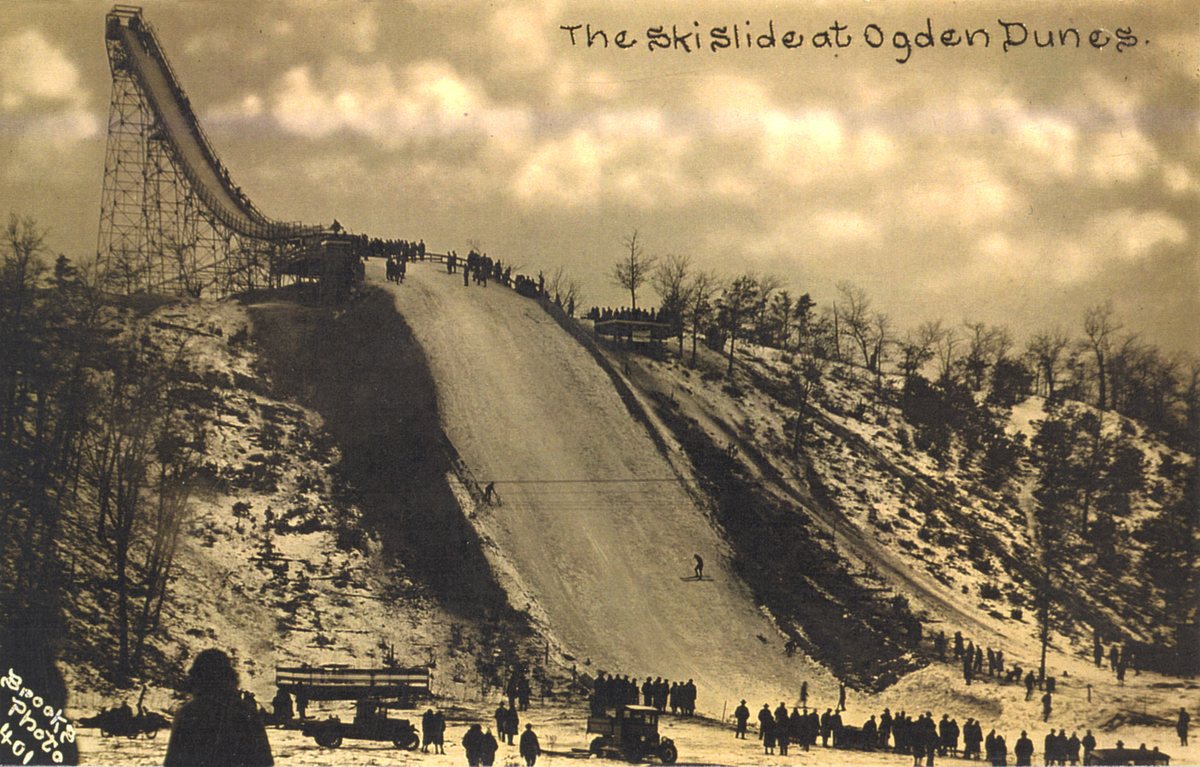
OGDEN DUNES, Ind. On Saturday, Jan. 24, 1931, the South Bend News-Times told its readers that special round trip fares to Ogden Dunes would be in effect on the South Shore Line the next day, that its regular trains would stop there during the meet, and that the fourth international ski meet, "which each year attracts thousands of spectators to Ogden Dunes," would start at 1 o'clock.
In a lakeshore town that today counts about 600 homes, a steel and wood ski jump once stood on a high dune, and for five winters, by the state marker's count, some of the best ski jumpers of their day came down it while the crowds stood along the hill below.
This look back is drawn from the Indiana Historical Bureau's marker at the site, the Town of Ogden Dunes, the Historical Society of Ogden Dunes, newspapers of the day digitized by the Library of Congress, a South Shore Line poster held by the Indiana State Library, and the old postcards and ticket stub that the collector Steven R. Shook has posted with his notes on the jump. Where those records disagree, and on this jump they often do, we tell you what each one says.
A resort town and a ski club
Ogden Dunes takes its name from Francis A. Ogden, who owned the land before his death in 1914, and the town was incorporated in 1925, the town's website says. The developers, led by Samuel Reck of Ogden Dunes Inc. and Ogden Dunes Realty, pictured a residential suburb and weekend retreat with a marina, riding stables and a golf course, the Historical Society of Ogden Dunes writes, and to stimulate sales they sold and leased land to what the society calls "a Norwegian/American ski jump association."
That association was the Grand Beach Ski Club, which later took the name Ogden Dunes Ski Club, and in 1927 it bought a piece of land on one of the town's high dunes, the town's history says. The society's timeline describes the club as made up of residents of Chicago and says it leased the land, and the state's marker says only that the club was incorporated in 1927 "to promote winter sports."
A tower on the dune
The jump cost $40,000, according to the society's Historic Trail page, which also quotes the club's chief engineer, Gustave Holm, telling reporters in 1927, "We estimate that the speed of the riders as they leave the slide will be more than 60 miles per hour, and the maximum jump should be more than 200 feet." The world amateur record at the time was 212 feet, the same page says, and the society writes that the jump was built to break records.
The town's history and the Shook notes put the jump at 192 feet tall in all, and Shook likens its rear tower to a 22-story building. A society photo caption says it "measured 200 ft. tall," the society's trail page gives a 345-foot ramp and a 225-foot tower, and the society's 2018 history calls the slide "590 feet long and thirty feet high." The marker says the jump had "adjustable height and length" and was "reputed to be the largest artificial ski jump at the time," and the town says it was once billed as the highest ski jump in the United States.
The old postcards show what it looked like: a steel tower standing over the top of the dune, a long wooden slide curving down from it, and below, a landing hill running down to the flat ground where the spectators gathered.
Five winters on the dune
The first meet was held on Jan. 22, 1928, according to the town, the society and the Shook notes, and the society's timeline says it drew nearly 10,000 spectators. The marker counts five annual events with international competitors from 1928 to 1932 and puts the crowds at 7,000 to 20,000, the trail page says 7,000 to 22,000, and the society's 2018 history adds that "actual numbers are difficult to confirm."
The railroad that ran past the dune courted those crowds with a poster by the artist Emil Biorn, a skier in a red sweater soaring over a crowd lining the hill, a train in the distance, and a promise of special low fares and fast limited trains from Chicago for a meet on "Sunday, January 12th." The poster is marked 1929, but a surviving club ticket printed for that Sunday reads 1930. That winter, wire photos of Casper Oimoen, a young jumper from Canton, S.D., at Ogden Dunes ran in papers from Connecticut to Alaska, and their captions did not agree: the New Britain Herald's put his leap at 160 feet and called it a new national record, and the Daily Alaska Empire's credited him with 169 feet and a course record.
A year later, on Jan. 25, 1931, Oimoen won the Ogden Dunes meet with two jumps of 168 feet, his 13th victory in 14 tournaments in a year, the Milwaukee Leader reported the next day. With the Winter Olympics coming to Lake Placid, N.Y., the next winter, the paper wrote that "America's hopes of scoring its first Olympic games ski triumph centered today on Casper Oimen," one of several spellings of his name in the papers of the day.
The society's trail page names others who came to the dune: Anders Haugen, the 1924 Olympic bronze medalist; Henry Hall, born in Ishpeming, Mich., who once held the world distance record; and the Norwegian brothers Birger and Sigmund Ruud. The longest jump ever reported on the hill was 195 feet, the town and the Shook notes say.
The Olympians come to Porter County
The winter of 1932 brought the Olympics to Lake Placid, where Oimoen placed fifth in ski jumping for the United States, according to the society. That same year, the town's history and the Shook notes say, the Norwegians who took gold, silver and bronze in ski jumping at Lake Placid, Birger Ruud, Hans Beck and Kaare Wahlberg, came to Ogden Dunes to try the tower, and the society's trail page says the Norwegian team tested the jump "and was impressed."
A ticket from the 1932 meet survives in the Shook collection, printed for "Sunday, January 12, 1930," with that date crossed out and "24 1932" written above it by hand. Admission was $1, with a South Shore stub good for passage to Wickliffe, the small railroad stop at Ogden Dunes.
The society's trail page notes that German forces imprisoned Birger Ruud in 1943 for speaking out against the Nazis, and that after his release in 1944 he joined the Norwegian resistance.
Snow, money and the end
The Depression hit the ski club and the young town together, and the society's timeline calls the closing of the jump in 1932 "a major blow," at a time when the 1930 census counted 50 full-time residents in 14 households. Snow was the other trouble: a society photo of the jump shows snow on the ground but none on the wooden slide, a condition the caption says "plagued the jump throughout its existence," and the Shook notes say low snow years forced the club to bring in snow from northern Michigan and Wisconsin.
The records part ways, too, on when the jump came down. The state marker says it was "dismantled after 1932 event," and the society's timeline says it closed that year, while the society's 2018 history says it came down in 1935. The town and the Shook notes say a ski club in Rockford, Ill., bought it in 1935 and moved it that summer, leaving only the concrete pilings, and the society's trail page dates the Rockford sale to 1936 and follows the tower on to Eau Claire, Wis., in 1955, where, the page says, it runs today as Silvermine Hill, part of a larger ski complex. The Shook notes even have meets running until January 1933.
Back in Ogden Dunes, the realty company regained the land the bankrupt ski club had leased and rezoned it for homes, the society says, and a small number of "fancifully themed arts & crafts houses" went up on the dune. A society photo taken after the jump was gone looks up the old hill toward the Frederiksen and Miller home at 26 Ski Hill Road, built in 1937.
What the town keeps
In 1997, the Indiana Historical Bureau and the Historical Society of Ogden Dunes put up a state marker at Kratz Field, 82 Hillcrest Road at Boat Club Road, at the foot of the old hill. The field is named for Ed Kratz, who served as town president from 1936 to 1957 and guided Ogden Dunes through the Depression and World War II, the society says.
The society, formed in 1988, keeps the town's archive and a small museum, The Hour Glass, at 8 Lupine Lane, with limited public hours, and can be reached at 219-763-0658. Its page on the jump mentions a 1996 research paper sent to the Historical Bureau and a 2006 video by resident Bill Warrick built from 1920s newsreel footage of the meets, and it ends with a request: "If you have any images of the jump we would love to have a copy!"
The steel went west and the crowds rode the South Shore home, leaving Ogden Dunes a street called Ski Hill Road and a marker at the foot of the old hill, where anyone who stands in Kratz Field on a winter afternoon and looks up the dune can picture what thousands came out to the lake to see nearly a century ago, a skier leaving a wooden slide high on the sand and, for a few seconds, flying.
See also
Label: Reported by us.
Corrections
No corrections to this story. If something here is wrong, tell us. Every correction is dated on the story and listed in our public log.
Sources (19)
- Ogden Dunes Ski Jump, state historical marker 64.1997.1, Indiana Historical Bureau
- Ogden Dunes Ski Jump historical marker, The Historical Marker Database
- About Ogden Dunes, Town of Ogden Dunes
- History, Town of Ogden Dunes
- Historical Society, Town of Ogden Dunes
- Ski Jump: 1927-1932, Historical Society of Ogden Dunes, July 9, 2018
- The Ski Jump, Historic Trail, Historical Society of Ogden Dunes
- Ed Kratz, Historic Trail, Historical Society of Ogden Dunes
- History of Ogden Dunes, Historical Society of Ogden Dunes
- 1920s and 1930s timelines, Historical Society of Ogden DunesAlso odhistory.org/announcement/1930s
- "Special Round Trip Ski Meeting Fares," South Bend News-Times, Jan. 24, 1931, page 4, Chronicling America, Library of Congress
- "Oimen Scores 13th Win in 14 Starts on Ski Slide," The Milwaukee Leader, Jan. 26, 1931, page 8, Chronicling America, Library of Congress
- International Newsreel photo of Casper Oimoen at the Ogden Dunes Ski Club meet, New Britain Herald, Jan. 17, 1930, page 28, Chronicling America, Library of Congress
- "Sets Ski Record," Associated Press photo, Daily Alaska Empire, Feb. 13, 1930, page 5, Chronicling America, Library of Congress
- Ski Meet Ogden Dunes, Sunday January 12th, by South Shore Line, poster by Emil Biorn, Chicago, South Shore and South Bend Railroad, 1929, Indiana State Library, via Wikimedia Commons
- Steven R. Shook, notes on the Ogden Dunes ski slide, with the circa 1928 postcard, Flickr
- Ski Tournament ticket, Ogden Dunes Ski Club and Chicago South Shore and South Bend Railroad, Jan. 24, 1932, Steven R. Shook collection, CC BY 2.0, Wikimedia Commons
- Ski Slide, circa 1932, postcard, Brooks Photo, Steven R. Shook collection, CC BY 2.0, Wikimedia Commons
- Photo: Ski Slide and Jump, circa 1928, postcard, Brooks Photo, Michael Fleming collection, via Steven R. Shook, CC BY 2.0, Wikimedia Commons


