




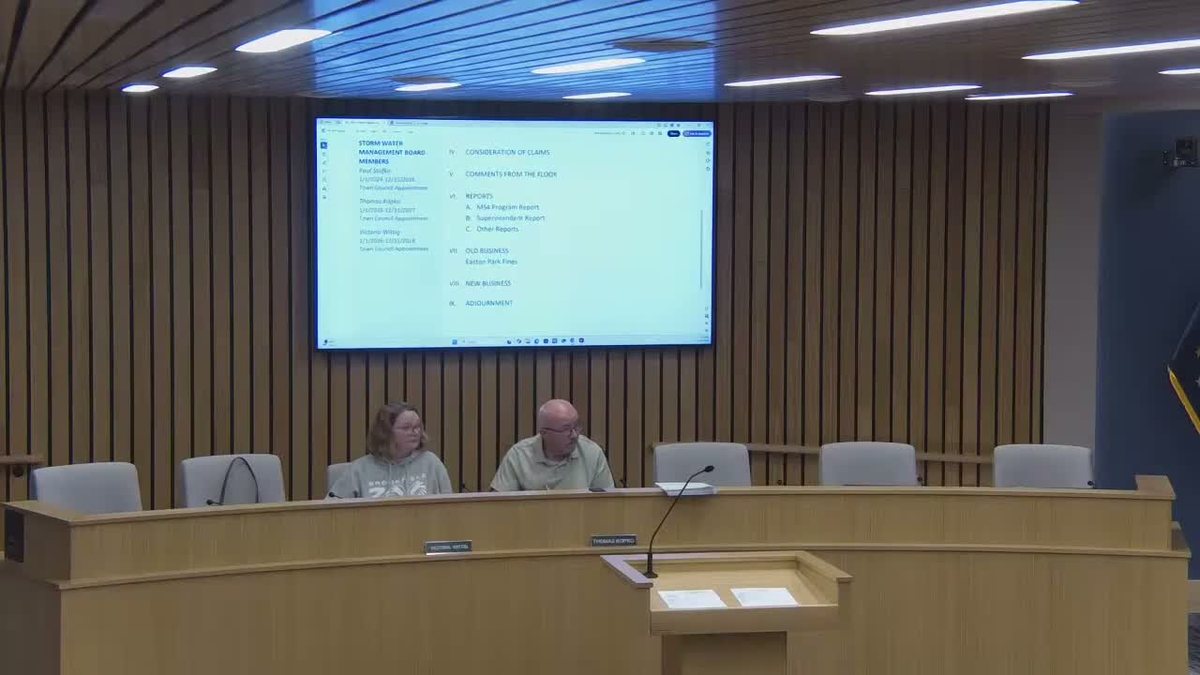
Chesterton's Storm Water Management Board took no action Monday, Nov. 16, on the $16,250 in additional fines town staff tallied in October against the developer of the Easton Park subdivision.
The fines were the only item listed under old business, and when the board reached it, President Thomas Kopko asked whether there were any updates on Easton Park. No update was given under the item, no motion on the fines was made, and the board moved on to new business seconds later. There was none, and the board adjourned at about 5:34 p.m., about four minutes after the meeting began with the Pledge of Allegiance.
Kopko and member Victoria Wittig were the only members at the dais; member Paul Stofko did not answer the roll call, and no one spoke during comments from the floor.
Earlier, in the stormwater (MS4) program report, a staff member who was off camera told the board that "they've made some repairs to deep erosion areas, but not across all of phase three, just in a few areas."
What the board had in front of it
The item came from the board's Oct. 19 meeting, where Chief Deputy Engineer Matt Gavelek reported that since the board last imposed fines, the developer's failure to stabilize the site had continued for 63 more days and sediment-laden water had left the site twice more during rain. At $250 for each second and later violation under the town code, he said, the additional fines come to $15,750 for the stabilization violation and $500 for the two releases, or $16,250. Gavelek and Superintendent Mark O'Dell said they would prepare a notice of violation and fines in those amounts with Town Associate Attorney Charles Parkinson, and the board took no vote on the amounts that night.
Olson Farm LLC holds the stormwater permits for Easton Park, and if the new amounts are imposed in full, they and the $7,250 the board set in September would total $23,500, by PC360's math. At the August hearing, Gavelek told the board the developer had "$1,600 in fines" to that date.
Asked by PC360 on Monday morning about the fines and the lawsuit, Kevin Nevers, the town's public affairs liaison, said he had no information about the court case and did not know whether the board would impose additional fines that night, or what they might be. PC360 asked the three board members, through town staff, Monday night, after the meeting, about the board's handling of the fines and what comes next for them and the stop work order.
How the fines began
The board first took up the violations at an Aug. 17 administrative hearing under Section 24-301 of the town code. Parkinson told the board that at the end of the hearing it was to decide whether the ordinance had been violated and, if so, whether to impose a fine or order other relief. Town staff presented the case, and the developer cross-examined the town's witnesses and presented its own evidence.
That night the board held off on a finding but voted 3-0 to amend the stop work order on the site so that a list of repairs had to be finished before it could be lifted. When Kopko asked whether the developer was still being fined each time one of the violations happened, O'Dell said staff had stopped issuing fines once the stop work order was in place but were documenting every occurrence. Parkinson told the board it had authority to fine during the stop work order.
On Sept. 21 the board voted 3-0 to adopt written findings that the developer broke two sections of the stormwater code: releasing sediment-laden water on six occasions, for a $1,500 fine, and failing to stabilize the site on 53 occasions, 50 of them in dry weather, for a $5,750 fine under the code's fine schedule, a total of $7,250, on a motion by Wittig that Stofko seconded.
The board's fines have been tested in court before: in June 2025, the Indiana Court of Appeals reversed a $100,000 fine the board had imposed on another developer, Olthof Homes, over its Springdale subdivision. The court found the town's penalty provisions "ambiguous at best" and sent the fine back to the board to be set again.
The stop work order
When staff reviewed the repair list Sept. 21, seven of eight items were unresolved, among them more skimmer capacity at Pond 2, seeding in Phase 3, a temporary berm behind Phase 2 back yards and the engineered fix for Phases 5 and 6 that was approved Aug. 10, and only the beaver traps were done. Kopko confirmed that no action was needed to keep the order in place, and it stayed in effect. At the Oct. 19 meeting, O'Dell said staff continue periodic observations at Easton Park.
The developer and the lawsuit
At the August hearing, Eric Gastovich, a principal of Olson Farm LLC, told the board the company had spent close to $500,000 on required erosion control at the development. He said Kemper Ditch, the regulated drain the property empties into, had lost all its capacity in the weeks before the hearing and backed water up five feet or more, and that he believed state drainage law required the town to present the county a plan for maintaining that outlet. Dave Westland, a Hammond attorney, represented the developer at the hearing.
In September, town staff said the town has no record of a request from the developer about the drain before late July, when a beaver dam was found, and noted that the hearing findings say the town is not responsible for maintaining the regulated drain.
At the Oct. 19 meeting, James Fetzer of Redwood Lane, speaking for the Easton Park Neighborhood Coalition, told the board the developer has sued the town. He said a Jan. 31, 2027, turnover under the homeowners' covenants would shift stormwater and infrastructure liability from the developer to homeowners, and he asked the town not to accept the subdivision's stormwater system until an independent engineer confirms it has been fixed. Wittig said the board was hearing the comments and taking them into consideration but could not respond because of ongoing litigation. The board and the Town Council met in a joint executive session Oct. 8 to discuss pending or threatened litigation.
The rest of Monday's meeting
The board approved the Oct. 19 minutes and the claims by voice vote. It also approved, by voice vote, a manual check for $306.91 to Hoosier Fire Equipment Inc. of Valparaiso for a 50-foot, inch-and-a-half fire hose that crews hook to a hydrant to clean out the street sweepers, a special order the town had already bought.
In the superintendent's report, the board heard that stormwater revenue for October was $68,533 against $35,103 in expenses, a $33,430 surplus for the month. The capital improvement fund held $57,167.11, the general fund $213,275.18 and the Trust Indiana fund $395,266.70.
What's next
The three members are appointed by the Town Council to staggered three-year terms: Kopko, whose term runs through 2027; Stofko, whose term ends Dec. 31; and Wittig, whose term runs through 2028. No more than two of them may belong to the same political party. The board supervises the town's municipal separate storm sewer system and meets the third Monday of each month at 5:30 p.m. at Town Hall, 726 Broadway, which puts its next regular meeting on Dec. 21.
Residents can speak during comments from the floor at the board's meetings, which stream live on the town's YouTube channel, youtube.com/@TownofChesterton. The board's staff contact is Gavelek, at mgavelek@chestertonin.org or the Building Department, 219-926-2610, and mail goes to the Storm Water Management Board at 1490 Broadway, Chesterton, IN 46304.
Label: Reported by us.
Corrections
No corrections to this story. If something here is wrong, tell us. Every correction is dated on the story and listed in our public log.
Sources (10)
- Video, Storm Water Management Board meeting, Nov. 16, 2026, Town of Chesterton YouTube
- Agenda, Chesterton Storm Water Management Board, Nov. 16, 2026, Town of Chesterton
- Email reply, Kevin Nevers, public affairs liaison, Town of Chesterton, to Porter County 360, Nov. 16, 2026; email, no web copy
- Opinion, Olthof Homes, LLC v. Town of Chesterton and Town of Chesterton Storm Water Management Board, Indiana Court of Appeals No. 24A-MI-1944, June 12, 2025
- Minutes, Chesterton Storm Water Management Board, Oct. 19, 2026
- Minutes, Chesterton Storm Water Management Board, Sept. 21, 2026
- Minutes and hearing transcript, Chesterton Storm Water Management Board, Aug. 17, 2026
- Minutes, joint executive session, Chesterton Storm Water Management Board and Town Council, Oct. 8, 2026
- Storm Water Management Board page, Town of Chesterton
- Staff directory, Town of Chesterton