




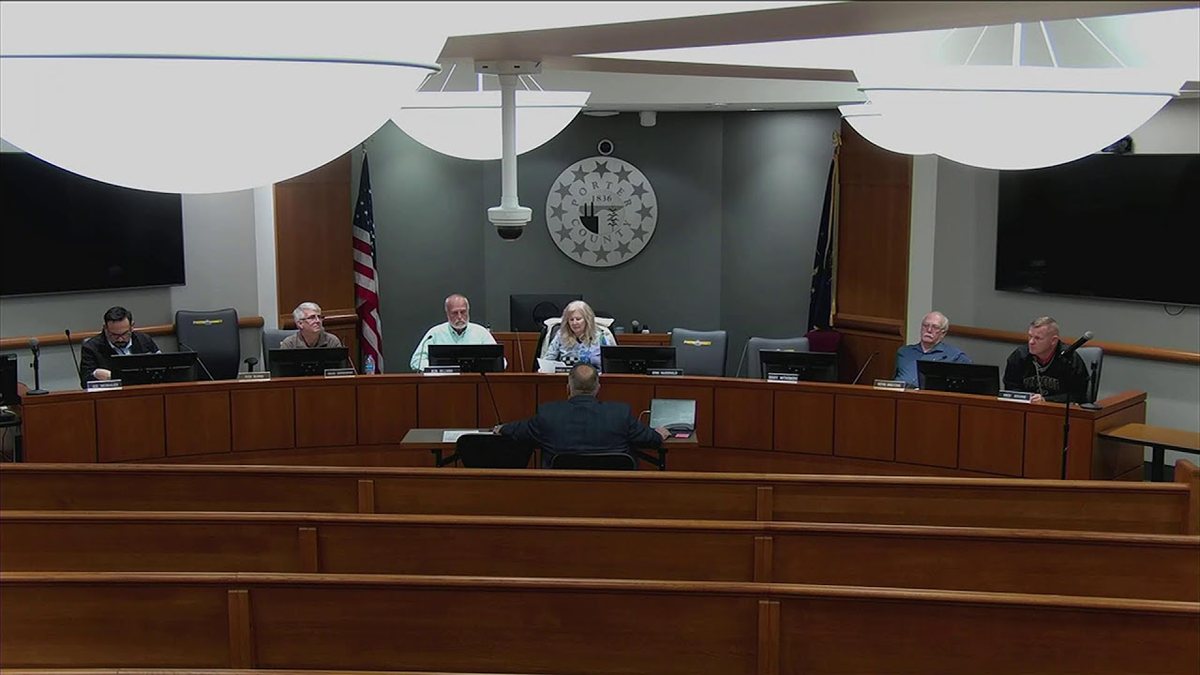
Porter County residents have until the end of business Friday, Dec. 11, to send written comments on the county's zoning and land development rules, after the Plan Commission held the public hearing the new state housing law requires and took no action Thursday, Nov. 19.
"The county is not proposing to change anything in our zoning, amend the Unified Development Ordinance or approve any development tonight," W. Michael Jabo, executive director of the county's Department of Development and Storm Water Management, told the commission at the start of the case. "Tonight is simply a listening session."
The hearing is the one House Enrolled Act 1001 requires of every Indiana county, city and town by Jan. 1, 2027: a public review of its development ordinance and zoning rules with the goal of increasing housing. The county's rules govern land outside the cities and towns that run their own zoning, and each of those cities and towns owes the state its own review. The law requires the review and a report to the state, but no section orders a county to adopt any of the changes it lists, such as allowing duplexes in single-family areas, permitting accessory dwelling units, or waiving minimum lot sizes and off-street parking.
Other parts of the same law do bind the county directly. Among them, after Dec. 31, a county, city or town may charge no more for building, zoning and subdivision application fees than it reasonably needs to cover processing and review, and may raise those fees only once every five years and by no more than inflation unless its costs change substantially. Two days before the hearing, on Nov. 17, the county commissioners gave first approval to an ordinance that Jabo said would generally raise his department's fees about 40%, the first change to them since 2019, and he called 2031 the department's next chance to raise them.
Jabo said no ordinance language was before the commission and no property was up for rezoning. Staff will sort the comments by subject and compare them with the county's comprehensive plan, its Unified Development Ordinance, the zoning map, infrastructure and existing development patterns, he said, and the county will send its report to the state by Dec. 31, ahead of the law's Jan. 1 deadline. Any change that grows out of the review would need its own proposal, public notice and hearings before both the Plan Commission and the Board of Commissioners, which makes the final decision.
Ideas for study, not proposals
Jabo listed subjects the county could study and said none was a proposed amendment: housing choices such as smaller detached homes, duplexes, townhomes and accessory dwelling units; lot and setback standards; whether growth areas line up with roads and utilities; reusing underused commercial or institutional properties for housing; parking and design standards; and whether reviews are clear and predictable.
He said the county's ordinance does not now allow a second home on a parcel, such as the "granny pod" some owners ask the Board of Zoning Appeals to approve for a family member. He told the commission that an early version of the state bill would have allowed duplexes and accessory units by right in all six of the county's residential zoning districts, and said he thought a blanket rule like that was wrong. Jabo said he and Commissioner Ed Morales testified on the bill while it was in the legislature.
Citing figures he recalled from the comprehensive plan work and said might not be exact, Jabo put the average price of a Porter County home at $331,000 as of a year ago and the average age of a first-time buyer at 41.
What commission members said
County Council Vice President Ronald "Red" Stone, who sits on the commission as a council member, thanked Jabo's staff and said he was open to ideas such as mother-in-law housing. "I think this is performative at best in my opinion," Stone said of the state's requirement. He said the legislature had pushed it down on local communities "in the guise of big business," for real estate developers who wanted "carte blanche" across the state.
Morales said "the bill was poorly written" and that the county is still catching up on infrastructure from its last growth spurt. Housing costs also turn on lumber, concrete, steel and other things the county does not control, he said.
Another member said the county once allowed accessory units but saw them turned into rentals, and said a subdivision of the lot would be the preferred way to make room for any new ones.
Porter County 360 asked Jabo, Morales and Stone by email Friday morning, Nov. 20, whether they wanted to add anything for residents. Any answers will be added to this story.
Two residents spoke
Jennifer Brock of unincorporated Center Township, speaking for herself and for the Porter County chapter of We Make Indiana, which she described as a nonpartisan group that unites faith communities and people of conscience across northwest and northern Indiana, asked what incentives the county could offer for higher-density affordable housing in places such as Wheeler. She asked whether lot sizes and parking minimums could shrink to save open space, asked whether the county's thoroughfare plan online still dated to 2007, and suggested allowing accessory units with a size limit on owner-occupied family farms. Jabo said later that the thoroughfare plan was updated this year and now includes routes for walking and biking, such as the major trail corridors.
Todd Leeth, who said he regularly appears before the county for clients seeking subdivisions, credited Jabo's office with a goal of finishing engineering reviews in 20 business days. He asked the commission to let small subdivisions of three or four lots stay "minor" subdivisions after an earlier land split, which now flips them into the major subdivision process. A project of a few lots needs a drainage plan, he said, but not a $10,000 or $12,000 study of the whole watershed. He also said the county's ordinance does not do a very good job of encouraging a mix of housing types.
What happens next
Jabo said a full update of the Unified Development Ordinance, folding in the 39 amendments approved since 2007 and correcting errors, will come to the Plan Commission in January and to the commissioners in January and February for approval as an ordinance. A rewritten section on planned unit developments is going out for review, and a second phase will look at subdivision rules, including minor subdivisions. A new comprehensive plan, the county's first full rewrite since 2001, is due for a public hearing in January, he said.
Six of the commission's nine members attended. President Rick Burns and members Erik McDonald and Nikky Witkowski were absent. Jabo said the hearing notice ran twice in the newspaper and on the county's website, and that one written comment had already come in.
Written comments may be dropped off at the department's office in Suite 311 of the County Administration Center, 155 Indiana Ave., Valparaiso, or emailed to Jabo at mike.jabo@portercountyin.gov through the end of business Dec. 11, he said. The commission next meets at 5:30 p.m. Wednesday, Dec. 9, a date moved up for the holidays, with at least one case on the agenda.
More from Porter County
- Porter County commissioners deny NIPSCO's revised heavy-haul route and give first approval to higher development fees
- Porter County redevelopment board hires a $3,800-a-month broker for South Haven and starts work on three development areas
- Porter County task force backs raising the local income tax to 0.75%, about $125 more a year on $50,000 of taxable income
Label: Reported by us.
Corrections
No corrections to this story. If something here is wrong, tell us. Every correction is dated on the story and listed in our public log.
Sources (6)
- Porter County Government, "Plan Commission, November 19th, 2026," meeting recording, YouTube
- Porter County Plan Commission agenda, Nov. 19, 2026, Case 26-PC-01
- House Enrolled Act 1001, 2026 session, Indiana General Assembly, IC 36-7-4.3
- We Make Indiana, home page
- Porter County 360, "Porter County opens its zoning rules to a Nov. 19 hearing under the new state housing law," Nov. 12, 2026
- Porter County 360, "Porter County commissioners deny NIPSCO's revised heavy-haul route and give first approval to higher development fees," Nov. 17, 2026