




VALPARAISO, Ind. On the afternoon of Sunday, Sept. 27, 1959, the order of service for Valparaiso University's new Memorial Chapel called for the doors to be touched with the cross and the mace, and for the chairman of the board of trustees, Paul Brandt, to open them from within and hand the keys to the university's president, the Rev. O.P. Kretzmann.
"In token that this building has been erected to the Glory of God and the service of this University," the printed booklet has him saying, "I deliver to you the keys thereof."
Later that afternoon, out at the new campanile, the booklet set down exactly how the bells were to speak: the largest bell "struck three times, thrice," then every bell in the carillon rung in turn from the highest note down to the lowest, three times over, and then the largest bell rung seven times. The prayer for the bells asked that their voice "may ever be a joyful sound."
It was the university's centennial year, and the chapel was the newest landmark of a school whose first college had opened on The Hill in 1859.
A college on the hill
The school began in 1859, when the people of Valparaiso met in the courthouse and gave $6,000 to start a Methodist college for young men and women together, the Valparaiso Male and Female College, according to The Vidette-Messenger's 1936 centennial edition. Its trustees bought 15 acres from the old Freeman estate, taking in the top of what townspeople called "The Hill," and classes opened on Sept. 21, 1859.
The Civil War and the unsettled years after it wrecked the young college, the 1936 history says, and by the early 1870s it stood vacant, its trustees left to decide what to do with the property.
Then a 26-year-old professor from a normal school in Republic, Ohio, Henry Baker Brown, heard about the empty buildings from a former Valparaiso student, came to look, and decided to start a school of his own. The Northern Indiana Normal School opened its doors on Tuesday, Sept. 16, 1873, to 30 students by the 1936 history's count, and it came to be known, the National Register nomination says, as "Mr. Brown's School."
Flint Hall becomes Heritage Hall
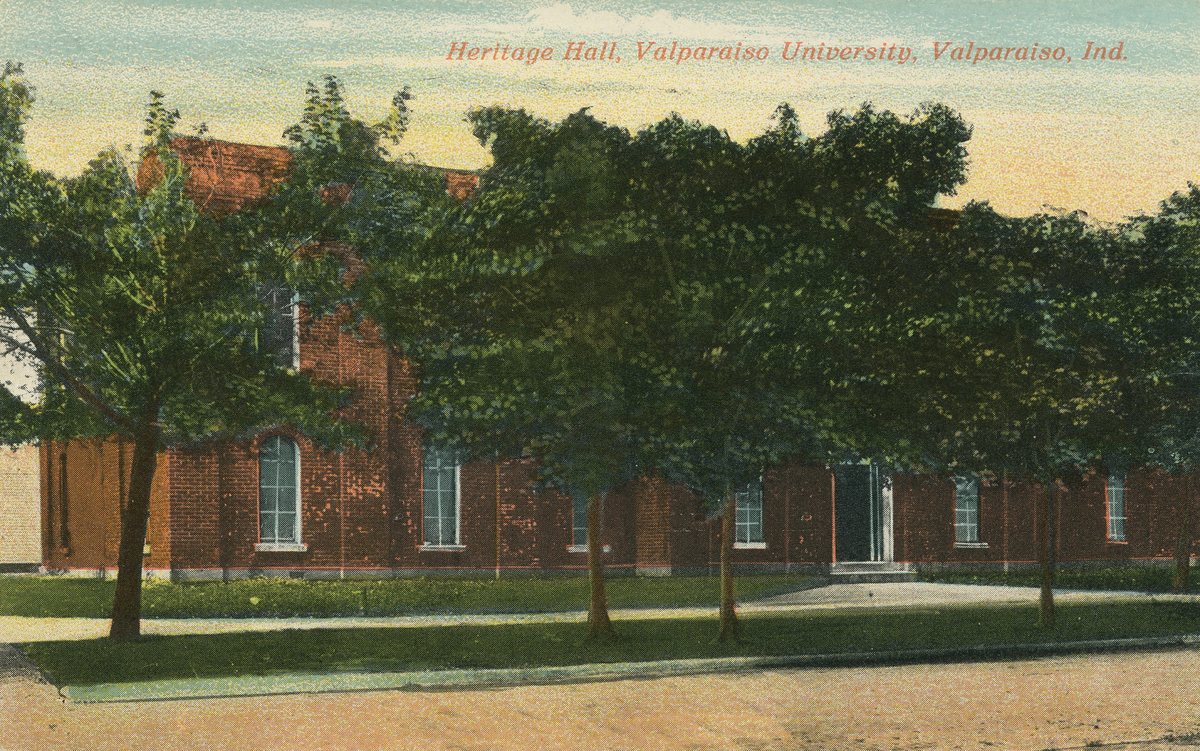
Two years later, in 1875, a local landowner named John Flint built a three-story brick boarding dormitory on College Avenue from brick made in the county, with a bracketed mansard roof and prominent dormers, according to the National Register nomination. Notes in the Steven R. Shook collection, drawn from the Porter County Vidette of the day, put its cost at $8,000 and its boarders at about 80 students.
On a winter morning, Jan. 25, 1881, fire broke out on the third floor, the Shook notes say, and the Vidette that week ran the news under a headline only a 19th-century newspaper could write: "Fire! Fire! Fire! Flint's Hall Burned Down! One Hundred Students Driven from a Hot House into a Cold World!" (The 1975 National Register nomination gives the year of the fire as 1879.)
The building survived as two stories under a flat roof, with its walls built up into a parapet to hide the new roofline. Richard A. Heritage, who led the school's music department, bought the damaged hall, the Shook collection notes say, and it took his name.
Its most famous resident, the nomination says, was George W. Norris, who remembered it as a "large three-story building which provided furnished rooms and board for men." Norris graduated from the school's law department in 1883 and went west to Nebraska, where he served in the U.S. House from 1903 and then in the Senate from 1913 to 1943, according to his congressional biography. He became known as the father of the Tennessee Valley Authority, whose first dam carries his name, and the National Park Service credits him with writing the 20th Amendment to the Constitution, which moved the start of a new Congress and the presidential inauguration up to January.
The Poor Man's Harvard
Brown's school grew on the idea that a good education should not cost much. The nomination says a term cost $8, and that the low price drew an enrollment second only to Harvard's.
By the winter of 1880 the work had grown so heavy that Brown asked a friend, Oliver Perry Kinsey, then teaching at a college in Lebanon, Ohio, to join him. Kinsey bought a share of the school, began work there in March 1881, took charge of the boarding and rooming halls and devoted himself, the 1936 history says, to "the problems which confront the student of slender means." It was chiefly his skill, The Vidette-Messenger wrote, that made Valparaiso known as "The Poor Man's Harvard." Brown, for his part, would travel all night in the worst weather to meet his grammar class at 6:30 in the morning. Their students went out to all parts of the world, and the Chicago alumni, the 1936 history says, made a pilgrimage back every year.
In June 1891, The Tribune of Chesterton reported that ground was being dug at the corner of College Avenue and Locust Street for a "magnificent college building," 120 feet by 60, with classrooms below and an auditorium above seating 2,000. "It is said the Auditorium will be the largest in Indiana, barring the Hall at Indianapolis," the paper wrote. The Auditorium went up in 1892, served for years as the campus's place for entertainment and was later turned into its chapel.
Hard years, and a new beginning
Brown suffered a stroke while visiting Boston in the fall of 1912 and lingered five years, the 1936 history says. World War I followed, and students whose schooling was paid for by friends and family in other countries found their money cut off, so Kinsey spent several hundred dollars, expecting nothing back, to help some of them find work or get home.
At Heritage Hall, a wood-framed barracks was added to the back of the building for soldiers during the war, the nomination says, and after the war the building served as the shop and classrooms for a federal program retraining veterans. By the 1936 account, the government sent 400 disabled veterans of the war to Valparaiso for vocational training.
The Old College Building, home of the library, burned in 1923, the university archives say. In 1925 the Lutheran University Association, organized by Missouri Synod Lutherans, set out to raise the money to buy and run the school, and the university's own history dates its purchase by the association to that year. Late that year the library moved into Heritage Hall, which took a great deal of work to make usable again after its wartime years.
When the chapel burned
On Nov. 27, 1956, the old Auditorium, by then the campus chapel, was destroyed by fire. Heritage Hall stood next door, still home to the library, and the university archives tell what happened next. Fearing the wind would carry the fire, students and faculty climbed onto Heritage Hall's roof and threw off the hot coals that landed there, while others hurried to carry out as many books as they could. The fire never reached the library, the archives say, though a number of the rescued books were dropped in the snow, and the rescue may have done them more harm than good.
A chapel for the second century
The new chapel was dedicated three years after its groundbreaking, the university's chapel history says. The building, designed by Charles Edward Stade and Associates of Park Ridge, Illinois, was first used for the university's opening convocation on Sept. 14, 1958, before its chancel windows, altar and pulpit were even in place, and was dedicated the following September as Memorial Chapel, a name given in recognition of the many memorial gifts that helped pay for it. It was renamed the Chapel of the Resurrection in 1969.
Its nave is 58 feet high and 193 feet long, and it seats about 2,000 people, the same number the old Auditorium had been planned to hold in 1891. Its basic structure was a thank offering from members of the Missouri Synod, and the dedication booklet thanks "thousands of friends" who gave toward it. Among its gifts was a narthex given by the Valparaiso University Alumni Association "in memory of the alumni who died in the service of their country."
The prayer of dedication gave thanks for "goodness to this University through the century past" and asked that the chapel be "an habitation of Thy glory now and in years to come."
Where they stand today
Heritage Hall was placed on the National Register of Historic Places on July 12, 1976, its nomination calling it the oldest building on campus and "the most appropriate symbol of a significant era in the history of the school." The library moved out to the new Moellering Library in 1959, and today the old hall, its address now 510 Freeman St., is home to the university's Office of General Counsel.
Since Nov. 16, 2021, both buildings have been on the National Register, and 67 years after its dedication prayer looked ahead to "years to come," the chapel is still in use. The Vidette-Messenger wrote in 1936 that the school's old students, passing anywhere near Valparaiso, would stop to "refresh cherished memories," and on the campus that grew from The Hill, an 1875 boarding house and a 1959 chapel are still keeping them.
See also
Label: Reported by us.
Corrections
No corrections to this story. If something here is wrong, tell us. Every correction is dated on the story and listed in our public log.
Sources (15)
- Heritage Hall, National Register of Historic Places inventory nomination form, prepared at Valparaiso University, Oct. 28, 1975, National Park Service NPGallery, NRIS 76000016
- Weekly List of Actions Taken on Properties, Nov. 19, 2021 (Valparaiso University Chapel of the Resurrection, listed Nov. 16, 2021), National Park Service
- History of the Chapel, Chapel of the Resurrection, Valparaiso University
- The Dedication of the Valparaiso University Memorial Chapel, order of service and acknowledgments, Sept. 27, 1959, Valparaiso University
- History, Valparaiso University
- Christopher Center Library: Before Moellering, Valparaiso University Archives
- "University Grew to Greatness From Humble Start," The Vidette-Messenger, Valparaiso, Aug. 18, 1936, centennial edition, as transcribed by Steven R. Shook, Porter County GenWeb
- "Valpo's New Normal College," The Tribune, Chesterton, June 26, 1891, as transcribed with the 1906 Auditorium postcard in the Steven R. Shook collection, Wikimedia Commons
- Heritage Hall at Valparaiso University, 1905, photograph by A. H. Reading, Steven R. Shook collection, with notes citing the Porter County Vidette of Sept. 9, 1875, and Jan. 27, 1881, Wikimedia Commons
- Auditorium, 1906, Porter County GenWeb, Historical Images of Porter County
- NORRIS, George William, Biographical Directory of the U.S. Congress, as published by the U.S. House of Representatives, History, Art and Archives
- George William Norris, National Park Service
- Office of General Counsel, Valparaiso University
- Office of the President, Valparaiso University, on the 2026 presidential inauguration in the Chapel of the Resurrection during Homecoming and Family Weekend
- Photo: Heritage Hall, Valparaiso University, 1912, postcard by the Commercial Colortype Company, postmarked Dec. 15, 1912, Steven R. Shook collection, CC BY 2.0, Wikimedia Commons


