




PORTER COUNTY, Ind. By the PC360 Community Desk
On Memorial Day 1917, a few thousand people sat on wet sand in a hollow between the dunes at Waverly Beach, huddled under umbrellas, and watched actors try to tell the history of the Indiana shore while it rained on all of them. The players got through the death of Father Marquette and La Salle's council with the Miami before "the rain came down in sheets," The Lake County Times of Hammond reported the next day, and by the end their voices were "finally drowned out by the thunder."
It was "a draggled, disgusted and disappointed crowd for the most part," the paper said, that piled into motor cars for the two-mile ride back to the station. The Times guessed the crowd at four or five thousand, and The Day Book of Chicago put it at about 6,000, sitting "with umbrellas and raincoats on sandhills" through the third of the pageant that was given. Four days later, on Sunday, June 3, the weather was perfect, in the Times' word, and 25,000 people filled the same sand to see the whole show.
The Historical Pageant of the Dunes, printed on its program as "The Dunes Under Four Flags," was staged for one purpose, to persuade the country to make the Indiana dunes a national park. This look back draws on the coverage in The Lake County Times and The Day Book of Chicago, both kept by the Library of Congress, on the pageant's own printed program, which the Lake County Public Library has put online, and on the National Park Service's administrative history of the dunes, written by historian Ron Cockrell in 1988.
A park for the Middle West
The idea took hold in the spring of 1916, when rumors spread, according to Cockrell's history, that Fort Creek at Waverly Beach would be dredged so lake ships could load sand straight from railroad cars, and members of the Prairie Club of Chicago, who kept a beach house in the dunes, voted to form the National Dunes Park Association. On July 16, 1916, a mass meeting at Waverly Beach brought three special trains from Chicago and 5,000 people, under the theme "A National Park for the Middle West, and all the Middle West for a National Park."
That fall, Stephen Mather, who would become the first director of the new National Park Service, held a hearing in Chicago where 400 people turned out and 42 spoke for the park, with no one speaking against it. His report, which went on to Congress, proposed buying a strip of lakeshore 25 miles long and a mile wide, 9,000 to 13,000 acres in all, by Cockrell's account. "The beauty of the trees and other plant life in their autumn garb, as I saw them recently, was beyond description," Mather wrote.
The opposition was centered closer to home, in Porter County, Cockrell wrote, where the press, business and political leaders and the Valparaiso Chamber of Commerce warned that a park that size would undermine the tax base and close the lakeshore to industry for good.
Save the country first
Within six months, the park lost two of its champions and then its moment. Sen. Thomas Taggart of Indiana, who had carried the park resolution in the Senate, resigned after losing his race in November 1916, and Mather suffered a nervous breakdown in the spring of 1917 and could not lobby. Then, on April 6, the United States entered World War I, and the slogan "Save the Dunes!" became, in the park service's telling, "First Save the Country, Then Save the Dunes!"
The park's backers answered with a show, building on the open-air festival the Prairie Club had held in the dunes each year since its beach house opened, which drew "a few hundred to 1,500 in the Spring of 1916," according to the program. The new Dunes Pageant Association, incorporated in Chicago in February 1917 with Jane Addams and the sculptor Lorado Taft among the names on its roll of officers and incorporators, set out to make it far bigger. Thomas Wood Stevens, president of the American Pageant Association, wrote the book, and Donald Robertson directed it and played the Prophet, whose verses carry the story from one episode to the next.
Porter County had its own hands in it, too: the program lists players from the University of Valparaiso in the opening Marquette scene and a local committee in Valparaiso, and its schedule for May 30 called for Boy Scouts from Kouts to raise a flag on Mount Tom, "the highest point in The Dunes," in view of the pageant site, with the flag donated by the park association's president, A. F. Knotts of Gary.
Four flags in a blowout
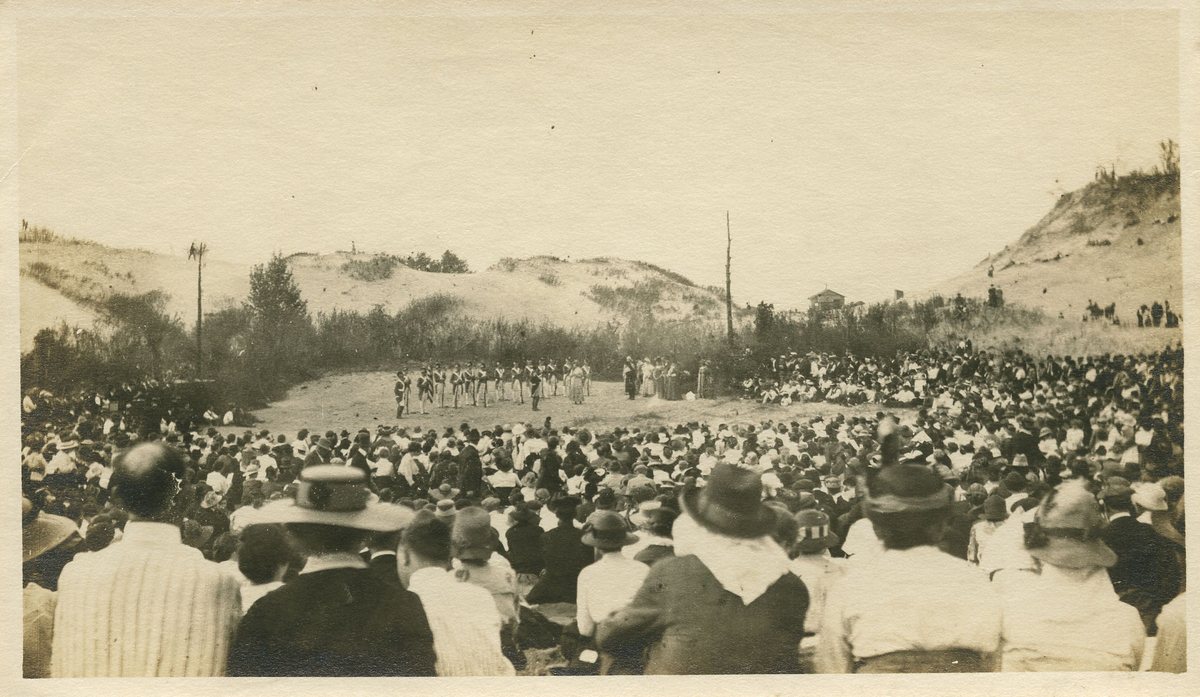
The stage was the Waverly Beach blowout, at the spot the 1917 papers called Port Chester, one of the wind-carved hollows between the sand hills, which the park service's history calls a natural amphitheater, in what is now Indiana Dunes State Park.
On June 3, the region's history passed across that sand in episodes, as the Times described them, from the death of Marquette and the landing of La Salle to a Spanish march from St. Louis to take Fort St. Joseph. In that march, the Times wrote, "the golden flag with its blood-red bars fluttered in a mild spring breeze," and "you forgot they were only De Paul university boys." Members of the Turner Society of Chicago brought back Fort Dearborn, and players from Gary closed the history with City West, the lakeside town its founders hoped would be "the metropolis of the west," and the visit of Daniel Webster. Joseph Bailly, the fur trader of Baillytown, was a character in that last scene.
Then came the masque, the poetry and dance half of the afternoon, with dancers as winds, waves, shore birds and wood nymphs under the direction of Mary Wood Hinman, some of them dancing to verses the poet Harriet Monroe wrote for the pageant. What the Times called "a memorable feature" was a dance by Dorothi Bock, "The Sorrowing Tree Heart," "expressing the sorrow of a tree over the peril of the dunes." The program printed the plea at the heart of it: "Grant us these haunts of beauty, Heart of Man, Heart of Man!"
At the close, the four flags of the title, French, British, Spanish and American, came back for a last review, and the Prophet, carrying the American flag, led the singing, as the program laid it out. "The great audience arose and sang 'The Star Spangled Banner,'" the Times reported, with a symphony orchestra under C. Gordon Wedertz.
The crowd was so large that four women fainted from the heat and sand dust and were treated at an emergency hospital, the paper said, and the money taken in at the gates was to go into the fund "to carry on the fight to convert the dunes into a national park." The Times counted 500 men and women and 300 children in the cast, while the park service's history puts it at 600 actors, and the park's website today puts the crowd somewhere between 25,000 and 40,000. The collector's notes with the photo on this story date the pageant May 30 and estimate 40,000, but the papers of that week put the full show, and its crowd of 25,000, on June 3.
'The first phase of the war'
On the same page as the pageant story, the Monday edition of the Times printed the rules for the draft registration set for the next day, June 5, when every man from 21 to 30 was to register between 7 a.m. and 7 p.m. in his home precinct.
On its front page, among the war dispatches, the paper ran a letter Knotts wrote that day to thank the pageant's organizers, and he borrowed the language of the hour. "The first phase of the war to 'Save the Dunes,' creating public sentiment, has been practically accomplished," he wrote. "What we need now is to enlist, organize and drill our army, and then when the opportune hour arrives, the battle will be won and the dunes saved."
Newsreels carried the pageant across the country, according to Cockrell's history, and every member of Congress received a copy of the pageant brochure. Still, as the war deepened, the park's backers conceded they could not halt the despoiling of the dunes while it lasted, and they vowed to renew the fight "the minute the war is over."
The park that came
The national park did not come then, because the federal effort "floundered badly in 1919," in Cockrell's words, and Indiana took up the cause itself. Gov. Warren McCray signed the bill authorizing Indiana Dunes State Park on March 6, 1923, Mount Tom became its first tract on Aug. 29, 1925, and the state park opened on July 1, 1926, drawing nearly 63,000 people in its first three months. State workers enlarged the existing parking lot at Waverly Beach to hold 850 cars.
In the Prophet's last verses in the program, he took his leave of the dunes and left them "forever" to the "dreamers, wanderers, / Who dance upon the dunes beneath thy stars," and the hollow where the crowd heard him lies today inside the state park, open to anyone who comes to walk the sand.
The bill creating Indiana Dunes National Lakeshore became law on Nov. 5, 1966, and on Feb. 15, 2019, Congress renamed it Indiana Dunes National Park, the country's 61st, 102 years after 25,000 people came to the sand at Waverly Beach to ask for one.
See also
Label: Reported by us.
Corrections
No corrections to this story. If something here is wrong, tell us. Every correction is dated on the story and listed in our public log.
Sources (9)
- "25,000 Thrilled," report on the Dunes Pageant at Port Chester, The Lake County Times (Hammond, Ind.), June 4, 1917, page 5, Chronicling America, Library of Congress
- "Spoiled Pageant," The Lake County Times (Hammond, Ind.), May 31, 1917, page 5, Chronicling America, Library of Congress
- A. F. Knotts letter to the Dunes Pageant Association, The Lake County Times (Hammond, Ind.), June 4, 1917, page 1, Chronicling America, Library of Congress
- "Dunes Pageant Will Come Off Next Sunday," The Day Book (Chicago), May 31, 1917, page 8, Chronicling America, Library of Congress
- The Dunes Under Four Flags: An Historical Pageant of the Dunes of Indiana, program, The Dunes Pageant Association and Thomas Wood Stevens, 1917, Indiana Room, Lake County Public Library, via Internet Archive
- A Signature of Time and Eternity: The Administrative History of Indiana Dunes National Lakeshore, Indiana, Chapter 1, Ron Cockrell, National Park Service, 1988, via NPS History
- Early Development of the Indiana Dunes: 1870s-1910s, Indiana Dunes National Park, National Park Service, last updated Oct. 11, 2023
- History & Culture, Indiana Dunes National Park, National Park Service, last updated June 17, 2026
- Photo: "Fort Dearborn Scene, Pageant of the Dunes, May 30, 1917, Chesterton, Indiana," as the collector titles it (the program lists the Fort Dearborn scene as the fifth episode, and the papers say only the first two were played on May 30, so it most likely shows June 3), photographer unknown, Steven R. Shook collection, CC BY 2.0, Wikimedia Commons (https://commons.wikimedia.org/wiki/File:Fort_Dearborn_Scene,_Pageant_of_the_Dunes,_May_30,_1917_-_Chesterton,_Indiana_(49572744633).jpg)