




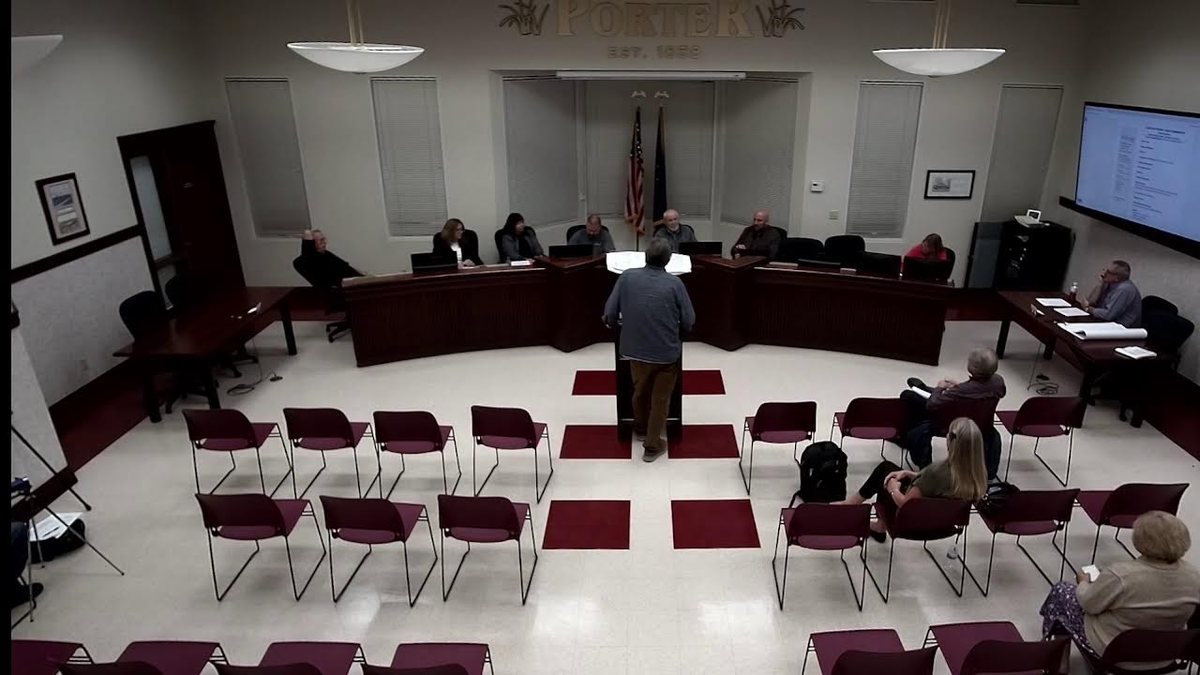
PORTER, Ind. Updated 6:10 p.m. Nov. 14, 2026.
The Porter Plan Commission will hold a public hearing Wednesday, Nov. 18, on an ordinance that would require owners of rental homes and apartments in town to register their units with the town, open them to inspections and meet a long list of minimum housing standards. The draft would also require a yearly town permit for short-term rentals offered on sites such as Airbnb, VRBO and Booking.com.
The meeting starts at 6:30 p.m. at Porter Town Hall, 303 Franklin St., and the agenda lists the "Proposed Rental Unit Ordinance" as its only public hearing. The commission is also set to review a proposed exterior lighting ordinance.
Back before the commission
The town first gave notice of a hearing on the rental ordinance for July 15. At the commission's Sept. 16 meeting, members opened the hearing on a revised draft, and a resident told them the revision had been posted only that Monday and asked for more time to review it. Michael Barry, the town's building commissioner and director of development, said he had finished the revision that Monday and did not want the commission to act on it that night, and that everything in it also applies to short-term rentals. The commission voted 5-0 to continue the matter to its next meeting.
The ordinance was also listed for a public hearing on the commission's Oct. 21 agenda.
The draft linked from the town's public notices page is a redline dated Sept. 14. What follows is from that draft; the version before the commission Wednesday may differ.
What owners would have to do
Every rental unit would have to be registered with the town by Jan. 1, 2027, and no one could keep a rental unit after that date without registering it. The application asks for the owner's contact information, proof of insurance, the number of private parking spaces, the unit's maximum occupancy, a statement that no homestead property tax deduction is being claimed on the property, and the owner's consent to an inspection. Owners who do not live in Porter County or a neighboring county would have to name a local agent, and an owner or the owner's representative would have to respond to emergency personnel within 30 minutes of being notified.
The registration fee in the draft is $5 for each rental unit, with a separate fee for short-term rentals. An inspection fee of $150 would be due before the town issues a registration permit, and rentals would be inspected at least every three years by the building commissioner and the fire chief or their designees. Inspections would be scheduled on weekdays between 9 a.m. and 4 p.m., and owners would have 30 days to arrange one.
Starting Jan. 1, 2027, the town could also inspect a rental after a complaint. There would be no charge if no violation is found and a $100 fee if one is. Reinspections after a deadline to fix problems would cost $100 per unit the first time and $200 after that. If an owner or tenant refuses entry, the draft directs the town to seek a warrant from a Porter County court. A permit would end 30 days after a property is sold, and the new owner would have to apply.
Owner-occupied single-family homes would be exempt, along with group homes, housing complexes owned by the federal government or a local housing authority, scattered-site Section 8 units the housing authority administers, homes being bought on a recorded contract, and hotels and motels.
The draft also strikes a line from its preamble that had said state law lets towns register and permit rental housing with only two limits: no fees for the permits, and no renewals until a property changes hands.
Standards inside the units
The draft caps occupancy at two people per bedroom, plus two for each finished basement, den, library or loft that could reasonably be used for sleeping, not counting infants under 1; the redline takes living rooms off that list and adds living and dining rooms to the spaces that may not be used for sleeping. It requires at least 120 square feet of floor space for the first occupant and 100 more for each additional person, working smoke detectors, a carbon monoxide detector in every unit and a fire extinguisher near the kitchen. From Oct. 1 to May 1 owners would have to keep habitable rooms at 68 degrees or warmer from 6 a.m. to 11 p.m. and at least 60 degrees overnight. Grass taller than 6 inches would have to be mowed, but the redline adds an exemption for native dune plantings, rain gardens, prairie restorations and pollinator gardens.
Short-term rentals
Short-term rentals, defined as stays of less than 30 days booked through a platform, would follow the same rules with additions. The permit application fee would be $150, and a permit would expire one year after it is issued. Every listing would have to show the town permit number, hourly rentals would be banned and the minimum stay would be one day. The draft bars using a short-term rental to house sex offenders, to run a structured sober living home or for an adult entertainment business. If a property draws three or more citations in a calendar year, the town could revoke its permit for up to a year. Owners who take bookings outside a platform would have to register with the state to collect the county innkeeper's tax and sales tax. An owner-occupied short-term rental would be a permitted residential use.
Penalties
Charges against an owner would go to the Porter Board of Zoning Appeals, which could put a permit on probation for up to three years, suspend it for up to 120 days or revoke it. In the redline several fines go up, and submitting false information could bring a fine of up to $250, or $500 for a repeat violation, up from $100 and $250. Knowingly allowing too many occupants could bring a fine of up to $200 a day, or $500 for a repeat, up from $100 and $250. The fine for threatening or filing an eviction to retaliate against a tenant who asked for an inspection would rise from $100 to as much as $2,500. The fine for renting without a permit is unchanged in the redline, at up to $100 a day, or $250 a day for a repeat.
Owners could also push back under the draft: a notice of violations would have to explain the owner's right to ask the Board of Zoning Appeals to change or withdraw it, and any decision by the building commissioner, who would serve as the town's rental housing officer, could be appealed to that board by a petition filed within 20 days after the decision is delivered or mailed.
What state law says
Indiana's law on regulating residential leases sets limits for rental programs, except programs created before July 1, 1984. A town may require a permit to lease a rental unit only if no fee is charged to obtain it and the permit does not expire unless the property changes hands, with one permit for a complex of five or more units. A yearly registration fee may be no more than $5, charged once for a rental complex or once for each parcel that holds a rental unit.
State law also exempts some rentals from town inspections and inspection fees: a unit managed by a professional real estate manager that was inspected in the past 12 months by or for a federal or state agency, a lender or insurer, or an architect, engineer or other qualified inspector who does not work for the owner, as long as the written report goes to the town by its due date. The town could still inspect such a unit after a complaint but could not charge for that inspection, and the Sept. 14 draft does not mention the exemption.
Short-term rentals fall under a separate state law, which the draft cites. It lets a town charge up to $150 for an owner's first short-term rental permit, or for a new one after a revocation, and says a permit expires a year after it is issued, but it bars any fee to renew a permit, including one that has expired. The draft sets the $150 application fee and the one-year term without saying whether the fee applies when a permit is renewed.
What happens next
The plan commission makes a recommendation, and the Town Council has the final vote; the draft's signature page lists council members Laura Madigan, James Burge, Don Craft, Kelly Karriman and William Lopez. Commission members are President Rob Albrecht-Mallinger, Tara Duffie, Jim Eriksson, Mary Burke, James Burge, Brian Bugajski and Jay Craig.
How to weigh in
Anyone may speak at the hearing in person or through an agent, and the town's hearing notice says written objections filed with the plan commission secretary before the hearing will be considered. The meeting will be streamed live at youtube.com/@porterindiana, and the town office can be reached at (219) 926-2771.
Also in Porter this week
The town's Environmental Sustainability Commission meets Tuesday, Nov. 17, at 7 p.m. at Town Hall. Its agenda lists a landscape code, an update on an Audubon grant, the Calumet Region Phragmites Master Plan and a Thanksgiving trash cleanup. That meeting will also stream on the town's YouTube channel.
Label: Reported by us.
Corrections
No corrections to this story. If something here is wrong, tell us. Every correction is dated on the story and listed in our public log.
Sources (8)
- Town of Porter Plan Commission agenda, Nov. 18, 2026
- Proposed rental housing ordinance, redline draft dated Sept. 14, 2026, Town of Porter
- Notice of public hearing before the Town of Porter Plan Commission, dated June 26, 2026, Public Notices page
- Town of Porter Plan Commission minutes, Sept. 16, 2026
- Town of Porter Plan Commission agenda, Oct. 21, 2026
- Indiana Code 36-1-20, Regulation of Residential Leases, sections 3.5, 4.1 and 5
- Indiana Code 36-1-24-13, short-term rental permits
- Town of Porter Environmental Sustainability Commission agenda, Nov. 17, 2026