




PORTER COUNTY, Ind. Updated 12:12 p.m. Nov. 17, 2026.
Correction, 12:12 p.m. Nov. 17, 2026: An earlier version of this story said Dunes Creek ran hidden beneath the paved camp lot for three quarters of a century, citing the DNR. The DNR's account says 70 years.
On July 1, 1926, Indiana Dunes State Park opened to the public, and the price of a day on the Lake Michigan sand was 10 cents a person, according to the Indiana Department of Natural Resources.
For the families who have spent their summers there in the 100 years since, the trip has its own familiar order: the drive to the north end of State Road 49, the stone gatehouses at the entrance, the long walk past the big pavilion and, at last, the first step into the lake.
A park the region fought for
The park started with a fight, as scientists, recreationists and nature lovers who saw the value of the Indiana dunes pushed in the early 1900s to have them preserved, and the state park was established in 1925, the DNR says. The Prairie Club, a Chicago organization, helped create it, and a memorial fountain designed by one of its members, a prominent landscape architect, was donated to Indiana in 1932 and stands today outside the park's Nature Center. Fifty years after its founding, in 1975, the park was named a National Natural Landmark.
The pavilion goes up
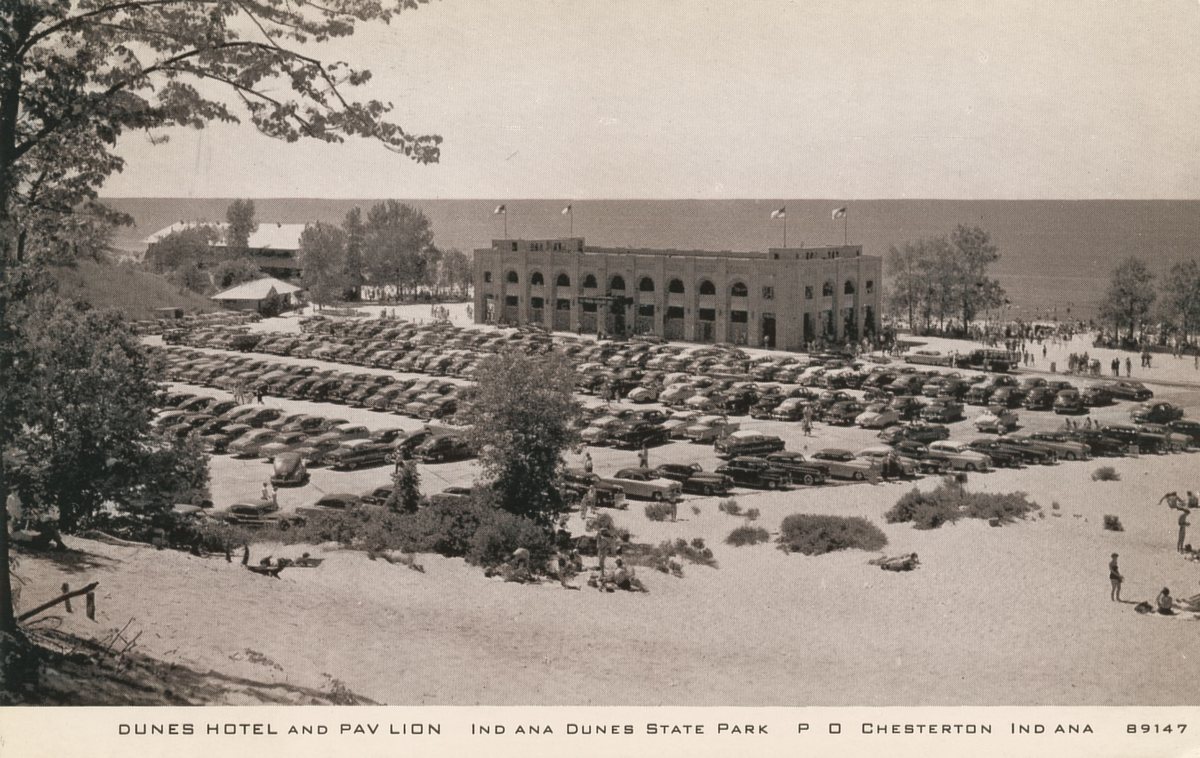
Work on the beach pavilion began in 1929 and was finished in 1930, at a cost of $100,000, according to the DNR. Inside were bathrooms, a bathhouse, a concession stand and a restaurant. Once the pavilion was built, the state dressed up the park with its stone entrance, where the gatehouses carry four uplifting quotes about nature.
The postcard makers took it from there, and an E. C. Kropp Co. card from about 1945 to 1950 promised "a fine two-story bathing pavilion" and concrete parking for 1,600 cars, along with a refreshment pavilion, hotel rooms, cottages and campsites, according to the card's text as recorded in the Steven R. Shook postcard collection on the Porter County GenWeb site.
The summer of 1936
By the middle of the 1930s, the beach was drawing crowds. The park counted 175,510 visitors in 1935 and more than a million and a half since it began keeping attendance in 1926, Outdoor Indiana magazine reported in 1936, and visitors from Chicago and the rest of Illinois had outnumbered Hoosiers at the park the year before.
That summer the park opened a first-aid station on the beach, and it did "a land-office business from early in the morning until late at night," the magazine wrote. The station looked after visitors who got too much sun or ate too much on their outing, served as a "parking" place for children who had become separated from their families, and its attendant once patched a rubber bathing suit that had split, "to the wearer's embarrassment." Another bather needed alcohol to wash the lake water out of a watch he had forgotten to take off before he plunged into the lake.
From the tops of the dunes, the magazine said, hikers could look far out over the water and, on a clear day, catch glimpses of Chicago, and on clear nights the city's lights were often visible from the park.
Visitors who wanted a bed could stay at the Arcade Hotel, on the beach, and take their meals at the pavilion next door, or book a cottage at the Duneside Inn in the eastern part of the park, reached through the Tremont entrance. The Duneside, a converted farmhouse north of the South Shore station at Tremont, charged $2.50 to $3.50 a day in 1932, meals included, according to the DNR, and neither the inn nor the Tremont entrance is there today.
The CCC boys of Company 556
The Great Depression brought another kind of visitor when Civilian Conservation Corps Company 556 arrived at the park on Oct. 27, 1933, the DNR says. Created by Congress that spring, the corps at first took unmarried men ages 18 to 25 for six-month enlistments, with World War I veterans allowed in as well, according to the National Park Service.
The young men paved a 3-acre site for their own camp and laid hundreds of feet of culvert to carry Dunes Creek beneath it, and the creek ran hidden under that lot for decades, until it was uncovered in 2009, the DNR says. The CCC also built Wilson's Shelter, which the park still uses.
Devil's Slide and the three dunes
A 1958 postcard called Devil's Slide "an unusual sand dune formation and a favorite playground" at the park. Today the 3 Dune Challenge sends hikers up Mount Jackson, 176 feet, Mount Holden, 184 feet, and Mount Tom, 192 feet, on a 1.5-mile course, according to Visit Indiana, and the park's Trail 8 crosses the tops of the three highest dunes.
By the pavilion sits the propeller of the J.D. Marshall, a sand-hauling ship that sank in a squall near the shore of the future park on June 10, 1911, killing four crew members. The wreck is now Indiana's first underwater nature preserve, the DNR says.
The pavilion today
Restoration of the pavilion began in 2015, according to the DNR, and the restored Dunes Pavilion now offers event space, meals, a rooftop bar and grill, beach supplies, snacks and ice cream, with hours that vary. The park covers 2,182 acres, with more than three miles of beach along Lake Michigan's southern shore.
The young men of Company 556 were not there for long, and on June 22, 1934, as the company got ready to move on to Pokagon State Park, a reporter for its camp newspaper, The Hoosier Dunesman, wrote, "we shall long remember the sky-blue waters of Lake Michigan and the sparkling sands of the Dunes." A century after the gate first opened for a dime, the water and the sand are still waiting at the end of State Road 49, and so is the pavilion.
See also
Label: Reported by us.
Corrections
Correction, 12:12 p.m. Nov. 17, 2026: An earlier version of this story said Dunes Creek ran hidden beneath the paved camp lot for three quarters of a century, citing the DNR. The DNR's account says 70 years.
If something else here is wrong, tell us. Every correction is dated on the story and listed in our public log.
Sources (8)
- Indiana Dunes State Park Centennial Challenge, Indiana Department of Natural Resources
- Indiana Dunes State Park, Indiana Department of Natural Resources
- "Three-Mile Beach on Lake Michigan Is Summer Playground for Hoosiers," Outdoor Indiana, Vol. 3, No. 7, 1936, pages 13 and 31, via NPS History
- Arcade Hotel and Pavilion in Indiana Dunes State Park, E. C. Kropp Co. postcard, circa 1945 to 1950, Steven R. Shook collection, Porter County GenWeb
- Devil's Slide, Indiana Dunes State Park, L. L. Cook Co. postcard, 1958, Steven R. Shook collection, Porter County GenWeb
- "Who Were the Men of the CCC?" Zion National Park, and "The Civilian Conservation Corps at Platt National Park," Chickasaw National Recreation Area, National Park Service, read Nov. 15, 2026Also nps.gov/chic/learn/historyculture/ccc.htm
- "Conquer the Challenge: 3 Dune Challenge," Visit Indiana, Apr. 25, 2025
- Photo: "Dunes Arcade Hotel and Pavilion at Indiana Dunes State Park, circa 1955," C. R. Childs Co. postcard, Steven R. Shook collection, Wikimedia CommonsAlso creativecommons.org/licenses/by/2.0
