




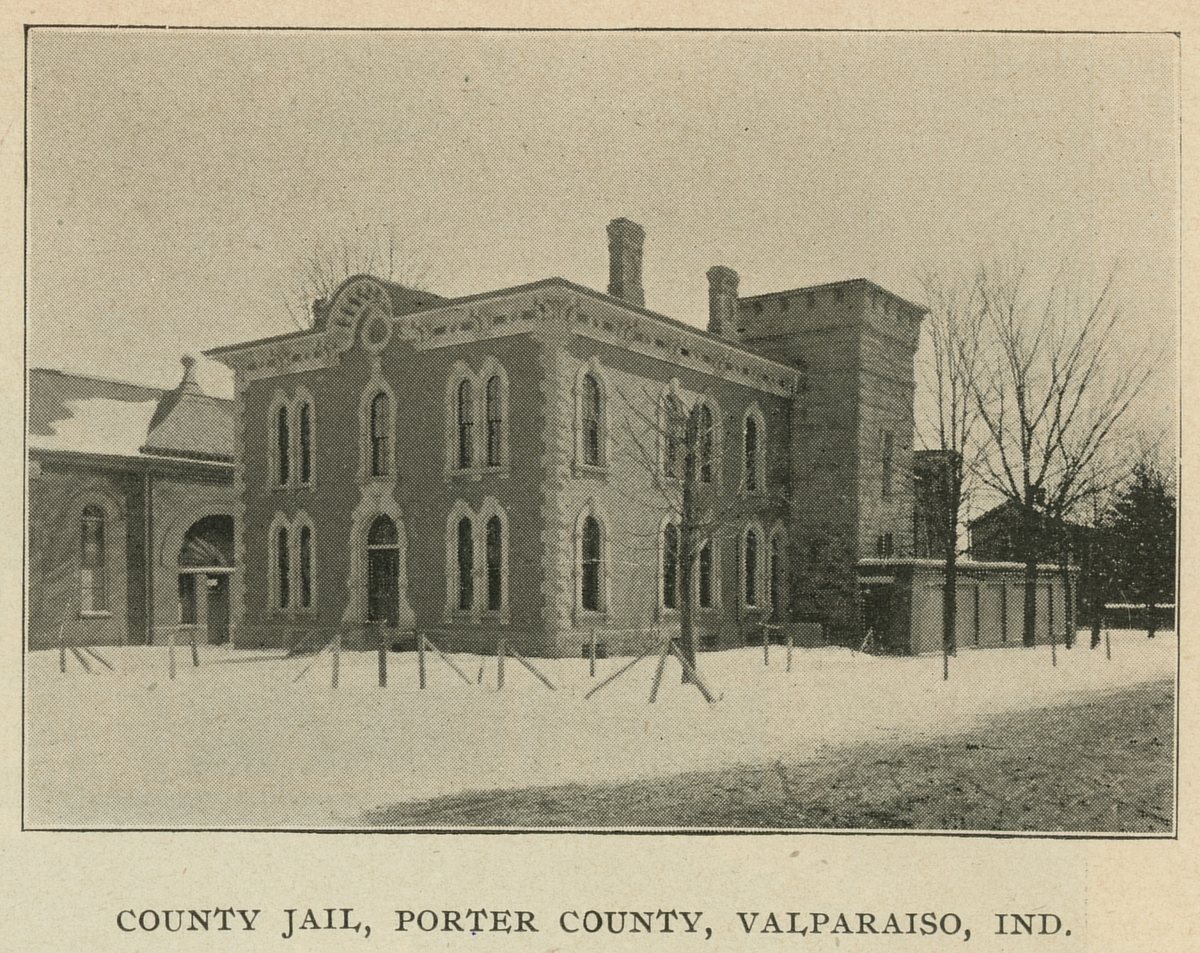
VALPARAISO, Ind. A photograph printed in 1898, in a Grand Trunk Railway magazine called "Headlight," shows a corner of Valparaiso the way generations of Porter County people knew it: snow across the yard, bare young trees braced with stakes, a tall brick house with paired arched windows and, rising behind it, a square stone tower that looks as if it wandered over from an English castle.
The tower belonged to the Porter County Jail, and the house was home to the county sheriff and his family. For just over a century, the two buildings at Franklin Street and Indiana Avenue kept the county's prisoners and its sheriffs side by side, and when the cells finally emptied in the 1970s, the county's history museum moved in and kept their stories for 45 more years.
A castle for the county seat
For some years before the jail went up, Porter County had no jail of its own, and prisoners were taken to La Porte County for safekeeping, according to an 1882 county history that is part of the building's file with the National Register of Historic Places.
The county commissioners bought the lot at the southeast corner of Franklin Street and Indiana Avenue for $2,200 on Dec. 17, 1870, and on March 8, 1871, awarded the contract to build a new jail for $24,325, the Porter County Museum's newsletter records. The cornerstone laid that year names R. Rose as architect, Shade & Lampke as builders and Wm. Davidson of Joliet, Illinois, as stonecutter, along with the county commissioners of the day, S.P. Robbins, A.B. Price and A.V. Bartholomew, according to the 1975 nomination that put the buildings on the National Register.
The jail was built of Joliet stone in the style of an English castle keep, the nomination says, with two square towers tying it to the sheriff's house and two round towers on the south end that were there only for looks, since there was no way inside them. The walls ran 19 inches thick, stone outside and brick and plaster within. The finished jail cost somewhat more than $26,500, the 1882 history says, and it called the building "a fine piece of architecture."
The house it was tied to was older, dated by the museum to about 1860, and the nomination describes two stories of red brick in the Italianate style, with paired round-arched windows, Joliet stone at the corners, a walnut stair rail climbing from the front hall and a small arched fireplace of white marble in each first-floor room.
That same year of 1871, fire tore through Chicago. One of the buildings left standing was the Chicago Water Tower, built two years earlier of yellow Joliet limestone in a castle-like Gothic style, and it came to stand for a city determined to rise from its own ashes, the Chicago Architecture Center says. Its architect, William Boyington, used the same stone and style for the prison at Joliet, and the Valparaiso jail built that year was cut from Joliet stone by a Joliet stonecutter.
Life beside the cells
A sheriff's home attached to the jail was a common arrangement in Indiana, the nomination explains, because the sheriff had to be on duty around the clock, and in such homes his wife would cook for the prisoners and act as jail matron, so a county got several services out of one house.
Robert P. Jones was the first sheriff to live in the residence when the jail opened in March 1872, the museum says, and the handcuffs he used that year, a design Andrew Rankin of Philadelphia invented in 1866, were still in the museum's collection in 2021, its newsletter said.
The jail got new cells and a heating system for $4,500 in 1883, which gave Porter County "one of the best jail buildings in the state," the museum's newsletter says, though the 1882 history notes that it was not always secure: several "jail deliveries," as escapes were called, startled the town, and in 1876 the jail held the "famous monte man and desperado known as 'Texas Jack.'" Crowds packed the courtroom for his hearing and came to the jail to see him, and then one night he was gone, helped out by accomplices, the history says.
Stories from the old kitchen and cellblock were still being handed down long after. Writing in the museum's newsletter in 2021, Executive Director Kevin Matthew Pazour recalled hearing from Wilma Luther about the Civil War-era cookie recipe her grandmother Della baked from in the kitchen while her grandfather, Lewis Green, was sheriff from 1904 to 1908. He remembered the late Bill Conover telling him that prosecutors called the place the "graystone hotel," for its whitewashed front and the "guests" checking in at all hours, and the late Ron Stevens, a deputy who married Sheriff Les Hineline's daughter Margaret, telling him that Porter County before the 1950s was a lot like Mayberry on "The Andy Griffith Show," except "we had eight or nine 'Otises' at any given time."
A girl in a cell and a hay wagon full of history
Bertha Stalbaum, the museum's longtime curator, laughed that she was now curator of a place where her grandmother had once been locked in a cell, The Vidette-Messenger reported in 1976, in a story the museum has since reprinted. Her grandmother, Elma Skinner Bull, used to tell her that in 1871, when she was 11 years old, she went with a school friend to look over the jail going up, and construction workers who were the friend's relatives playfully locked her in a cell.
In March 1971, a century after the jail went up, Porter Circuit Judge Alfred J. Pivarnik signed the order that let the county take land south of the old jail for a new one, paid for with $1.96 million in bonds, The Vidette-Messenger reported. The new jail went up on Franklin Street in 1974, and the old jail and the sheriff's house were retired from the work they were built for, the Porter County GenWeb history notes.
The county's museum, which had outgrown its rooms in the courthouse, began moving into the old jail on Sept. 17, 1974, and the Old Jail Museum opened its doors on May 11, 1975, the museum says. Stalbaum's family carried many of the pieces over from the courthouse on their own tractor and hay wagon, and two trucks and three men from Landgrebe Motor Transport needed three days to move the rest. "This is the first and only museum I ever moved, and I don't want to move any more," she told the paper with a laugh.
Stalbaum also helped prepare the nomination that placed the jail and the sheriff's house on the National Register on June 23, 1976, in the summer of the nation's Bicentennial. That spring, three sheriff's deputies in 1800s western dress, with replica six-shooters on their hips, began their duties as Bicentennial police and posed for the newspaper in front of the old jail. That same year, the Hollywood character actress Beulah Bondi, who grew up in Valparaiso, visited the Old Jail Museum with Stalbaum, the museum's history shows.
A new home on Indiana Avenue
The museum took back the name Porter County Museum in 2007 and took on the nickname PoCo Muse in 2012. It closed its doors in the 1871 jail on March 12, 2020, because of the COVID-19 pandemic, and reopened on May 19, 2022, in a remodeled building at 20 Indiana Ave., its long-term home, the museum says.
On Nov. 7 the museum opened "Not for Glory: Porter County and the Civil War," about the more than 1,000 county residents who left home to support the Union in the years when the sheriff's house was new. The museum is open 11 a.m. to 5 p.m. Tuesday through Sunday, and admission is free.
The old house and its stone tower still stand on the corner beside the Memorial Opera House. Elma Skinner Bull told her granddaughter about the day the workmen locked her in a cell, and that granddaughter grew up to be the curator of a museum inside those same walls, where she could laugh about it among the exhibits a century later.
See also
Label: Reported by us.
Corrections
No corrections to this story. If something here is wrong, tell us. Every correction is dated on the story and listed in our public log.
Sources (12)
- National Register of Historic Places Inventory, Nomination Form, Porter County Jail and Sheriff's House (Historical Society of Porter County Old Jail Museum), prepared March 19, 1975, National Park Service, NRIS 76000017, with the attached pages of "Counties of Porter and Lake, Indiana," Weston A. Goodspeed and Charles Blanchard, F.A. Battey & Co., 1882
- History of the PoCo Muse, Porter County Museum
- About the PoCo Muse, Porter County Museum
- PoCo Muse News, January and February 2021 and July to September 2021, Porter County MuseumAlso pike-tulip-nbe2.squarespace.com/s/SM2021MuseNewsDIGITAL.pdf
- Looking Back a Century, Porter County Jail, Porter County Museum, reprinting The Vidette-Messenger of Porter County of March 9, 1971, March 6, 1976, and April 7, 1976
- Not for Glory: Porter County and the Civil War, and Admission & Hours, Porter County MuseumAlso pocomuse.org/admission-hours
- County Jail, Porter County, 1898, Historical Images of Porter County, Porter County GenWeb
- History, Memorial Opera House
- Beulah Bondi, Wikipedia, read Nov. 14, 2026
- Chicago Water Tower, Chicago Architecture Center
- Porter County to rent former sheriff's residence to artisan boutique business, Lakeshore Public Media, March 13, 2024
- "Porter County Jail, 1898 - Valparaiso, Indiana," Headlight Engraving Co. photograph from "Headlight: Sights and Scenes Along the Grand Trunk Railway," Steven R. Shook collection, Wikimedia Commons, license CC BY 2.0, unalteredAlso creativecommons.org/licenses/by/2.0
