




VALPARAISO, Ind. Updated 7:55 p.m. Nov. 14, 2026.
Correction, 7:55 p.m. Nov. 14, 2026: An earlier version of this story credited the plaque at the statue for the detail that Orville Redenbacher began wearing his red bow tie while the partners were selling Red Bow seed. That detail comes from the Purdue University Retirees Association's history of him, and the plaque does not mention the bow tie.
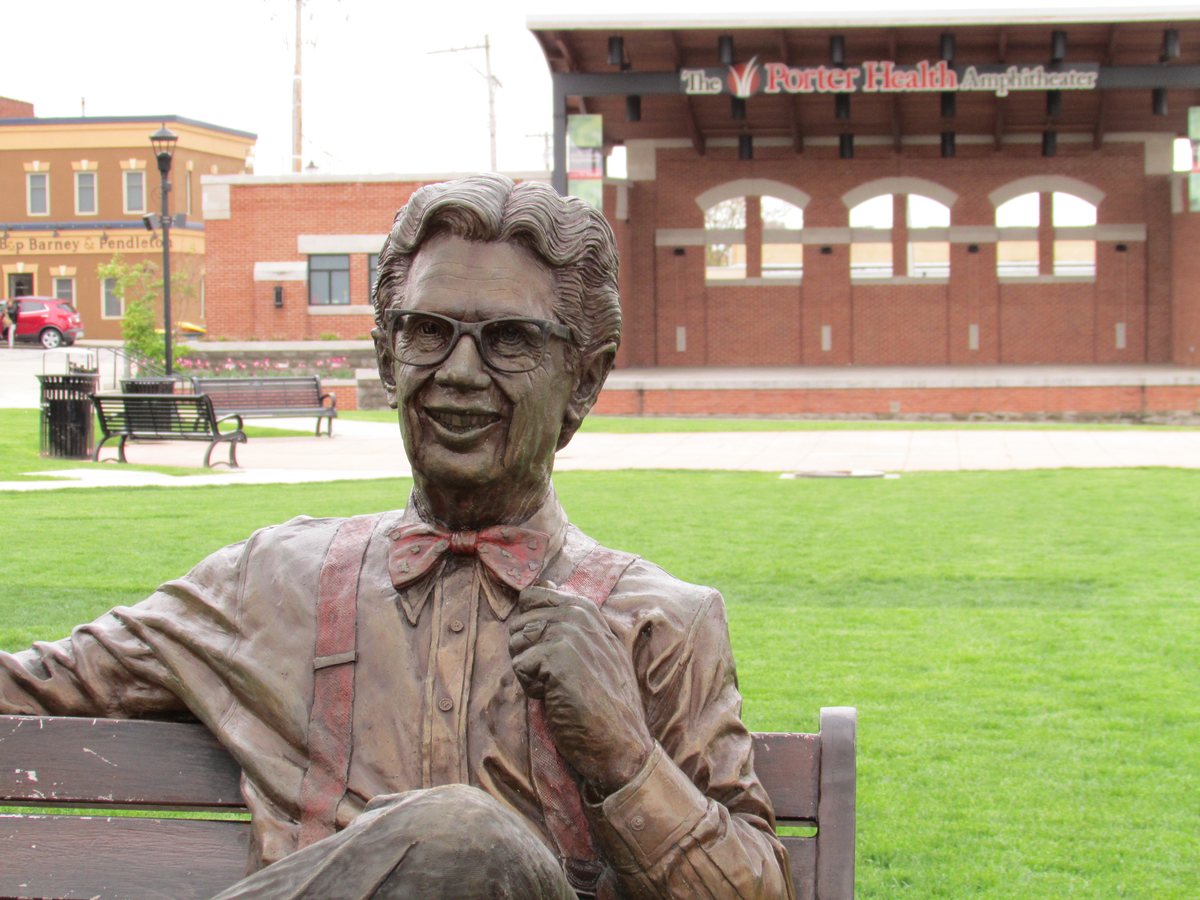
At the north end of Central Park Plaza, just off Lincolnway, a bronze Orville Redenbacher sits on a park bench in his big glasses, bow tie and suspenders, one hand resting at his chest and a wide grin on his face, as if he's been waiting for someone to sit down and talk popcorn.
He's kept that seat since Sept. 4, 2012, when the statue by sculptor Lou Cella was dedicated, the plaque beside it says. Long before he was the face on the package, though, he was a Porter County seed man, and the kernel that made his name famous was bred here.
A farm boy with a cash crop
Redenbacher was born July 16, 1907, on a farm about seven miles south of Brazil, in Clay County, and at about 12 he was raising popping corn and selling it on the cob in 50-pound sacks to stores in Brazil and Terre Haute, Purdue University's retirees' history of him says. He went on to Purdue, where he earned his agronomy degree in 1928 and played tuba in the marching band, the Purdue history says, and the band, he later joked, was "where I learned to toot my own horn," The Associated Press reported in 1995.
He became a county agent in Vigo County, then managed Princeton Farms in southern Indiana, where in 1941 he began planting hybrid popcorn seed developed by Purdue scientists, the Purdue history says.
Coming to Porter County
His friend Charles Bowman, another Indiana farm kid and Purdue graduate, had been asked to manage what the Purdue history calls the oldest seed corn business in Indiana, owned by George and Marie Chester, and late in 1950 George Chester called and offered to sell it. Bowman called Redenbacher and proposed they buy it as partners, and Orville and his wife, Corinne, packed up for Boone Grove.
Sources differ on the year of the purchase: Indiana Humanities says the partners bought the George F. Chester and Son seed corn plant near Valparaiso in 1951, when they renamed it Chester Hybrids. The Purdue history says Redenbacher organized Chester Hybrids with Bowman in Valparaiso in 1952, and Chester Inc., still in business today, dates its own start to 1947.
In 1959 plant breeder Carl Hartman joined Chester and planted 3,000 popcorn plants of 83 varieties on a single acre, the Purdue history says. The partners sold their seed as Red Bow, "Red for Redenbacher and Bow for Bowman," as the plaque downtown puts it, and around then, by the Purdue account, Orville started wearing his signature red bow tie.
By 1965 Hartman had it: a light, fluffy corn that left few unpopped kernels and passed the test of 44 times its volume popped. Orville wandered the room, the Purdue history recalls, saying only, "We made it! We made it!"
Putting a face on the brand
Red Bow Popcorn grew into one of the largest wholesale popcorn distributors in the Midwest, known for its quality and high popping volume, and Bowman felt it needed a stronger brand to go nationwide in stores, so the partners chose Orville's name and likeness, the plaque says. Around 1970 they began marketing Orville Redenbacher Gourmet Popping Corn, and within a few years it held a third of the market for unpopped popcorn, according to Indiana Humanities. The brand still repeats what it calls the promise Orville made more than 40 years ago: "You'll like it better or my name isn't Orville Redenbacher."
He sold the company to Hunt-Wesson Foods in 1976, and the brand has belonged to ConAgra since 1990, Indiana Humanities says. He kept making the commercials after the sale, the AP reported, and he later moved to Coronado, Calif., according to the retirees' history.
A festival of its own
Valparaiso started its Popcorn Festival in 1979 to mark his success, held on the Saturday after Labor Day, according to Indiana Humanities. A wooden token from 1981 in Steven R. Shook's collection reads "3rd Annual Valparaiso 1981 Popcorn Festival" on one side, and on the other offers a free medium drink at Wendy's with any sandwich, good until Sept. 30, 1981.
Valparaiso Events, which grew out of the festival and runs it today, bills its parade as the nation's first Popcorn Parade.
In 1995, Orville couldn't make it back for the 17th festival on Sept. 9, and he died 10 days later at his apartment in Coronado, at 88, the Purdue history says. Bowman died April 8, 2009, the plaque records.
What you can still see
The idea for the statue, as The Times of Munster reported and the AP carried in 2011, was to put Orville on a bench in a city park where visitors could pose for pictures with him, and that is how he sits today, under the plaza's overhead entrance on Lincolnway, about 80 feet east of Lafayette Street. The plaque beside him tells the story of both partners and closes it with this line: "Charlie and Orville were always proud to call Valparaiso their hometown for family and business."
Chester Inc. still keeps its headquarters at 555 Eastport Centre Drive in Valparaiso, now in farm irrigation, grain handling and construction work, according to the company.
The festival keeps coming back, too, and the 47th Valparaiso Popcorn Festival ran downtown on Sept. 12, with the Popcorn Parade at 10 a.m., more than 340 vendors and the theme "Poppin' Through The Decades," Valparaiso Events says.
More than half a century after his gourmet popping corn first reached store shelves, the man in the bow tie still sits on his bench in the plaza, keeping an eye on the crowds that come back in September to the city where his famous kernel was bred.
See also
Label: Reported by us.
Corrections
Correction, 7:55 p.m. Nov. 14, 2026: An earlier version of this story credited the plaque at the statue for the detail that Orville Redenbacher began wearing his red bow tie while the partners were selling Red Bow seed. That detail comes from the Purdue University Retirees Association's history of him, and the plaque does not mention the bow tie.
If something else here is wrong, tell us. Every correction is dated on the story and listed in our public log.
Sources (10)
- The story of Orville Redenbacher and Charlie Bowman, plaque at the statue in Central Park Plaza, Valparaiso, dedicated Sept. 4, 2012, as transcribed and photographed by the Historical Marker Database
- Orville Redenbacher, PURA Historic Purdue Characters Project, Purdue University Retirees Association
- Orville Redenbacher, Indiana Humanities, Oct. 21, 2010
- "Orville Redenbacher Dead At 88," The Associated Press in The Seattle Times, Sept. 19, 1995
- "Valparaiso wants statue to honor Orville Redenbacher," The Associated Press, citing The Times of Munster, via WBEZ Chicago, Aug. 10, 2011
- Brand History, Orville Redenbacher's, Conagra Brands
- About, Chester Inc.
- Valparaiso Popcorn Festival and About, Valparaiso EventsAlso valparaisoevents.com/about
- "Valparaiso Popcorn Festival, 1981, Token," Steven R. Shook collection, Wikimedia Commons, CC BY 2.0
- Photo: "Redenbacher 2016-05-04 026.jpg," Chris Light, May 4, 2016, Wikimedia Commons, license CC BY-SA 4.0Also commons.wikimedia.org/wiki/File:Redenbacher_2016-05-04_026.jpg

